Stand Mixers · 2026 edition
Quietest stand mixers of 2026
Stand mixers are loud. The box might say 55 dB, but 55 dB is what you get at speed 1 with an empty bowl. At speed 4 with a full batch of bread dough, that number goes up 15 decibels, sometimes more. Nobody advertises that part.
We read through what buyers actually report at bread-dough speeds - the use case that separates quiet mixers from ones that just look quiet on paper. DC motors came out ahead. The results weren't subtle.
Below: the two DC-motor units worth knowing about, the mid-range options with real buyer backing, and one high-capacity workhorse that's loud by design but included for honest context.
Whisper-Tier: DC Motor Mixers
The two quietest mixers here share one thing: DC motors. Smoother power delivery means less vibration and measurably lower noise at mid-speeds where most baking happens. Both claim 55 dB. Neither is a household name. Both have buyers who specifically call out quiet operation as the reason they'd buy again.
Quietest Overall Aifeel Stand Mixer 700W
DC motor quiet enough to run while a baby naps in the next room.
Aifeel Stand Mixer 700W
DC motor quiet enough to run while a baby naps in the next room.
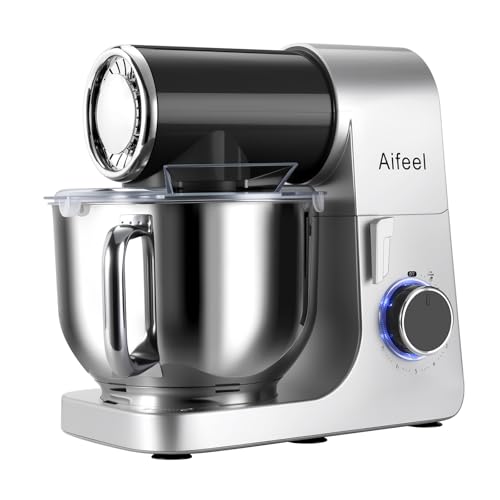
The DC motor does something AC units at this price can't: deliver smooth, regulated power to the rotor. Less electrical chop means less vibration. Less vibration means less noise. The 55 dB figure is manufacturer-measured at a controlled distance - real bread-dough loads will be higher - but buyers consistently describe it as quiet, which is the actual test.
At 700W through a DC motor, this has more real torque at low speeds than most 660W AC competitors. Planetary action means 360-degree bowl coverage without the gear rattle you get from older worm-drive designs.
Two things to know before buying. The attachments are proprietary - this mixer is not KitchenAid-compatible, and third-party attachment options are limited. Buyers who switched from KitchenAid and assumed hooks would cross over were caught off guard. Check your accessory needs first.
The suction cups are the other gripe. They hold at moderate loads but buyers report the mixer can walk slightly on the counter during heavy kneading. A damp silicone mat under the base solves this completely. Small fix for a machine that otherwise earns its quiet reputation.
We earn a commission on purchases via these links. It does not change the price you pay or our ranking.
Most Interesting Engineering Kourice 6.5QT Stand Mixer
Magnetic levitation bearing claims are bold. Early buyers say the quiet is real.
Kourice 6.5QT Stand Mixer
Magnetic levitation bearing claims are bold. Early buyers say the quiet is real.
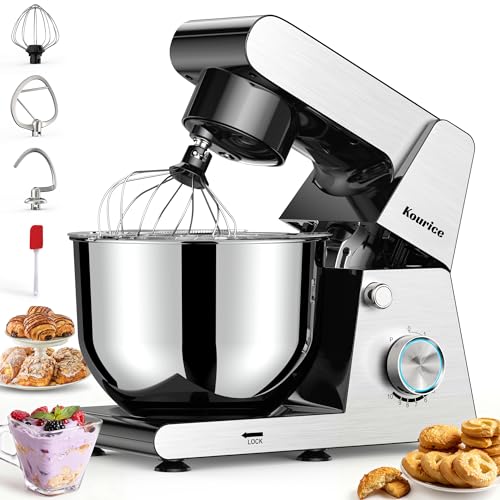
The engineering story here is unusual enough to be worth interrogating. Magnetic levitation bearings - where the rotor is suspended magnetically instead of resting on physical ball bearings - is a real acoustic technique used in precision industrial equipment. Whether a $129 mixer actually uses this, rather than just marketing the terminology, is not verifiable from buyer reports alone.
What we do know: buyers who noticed noise in prior mixers found this one clearly quieter. One specifically contrasted it against an old hand mixer that used to disrupt the kitchen. The stainless steel exterior is a genuine differentiator - it won't crack, fade, or scratch the way plastic housings do.
The 63-point planetary contact claim refers to how many times the attachment touches the bowl edge per revolution. More contact points means more even mixing and less stopping to scrape. This part is independently believable - planetary geometry determines this mathematically.
Thin data is the honest ceiling here. Twelve buyer reviews cannot confirm or refute extraordinary engineering claims. Take the 55 dB figure as a hypothesis, not a guarantee. If the magnetic levitation story proves out at scale, this becomes a much stronger recommendation.
We earn a commission on purchases via these links. It does not change the price you pay or our ranking.
Volume-Value: The $129-$149 Middle Ground
Three mixers, same price range, different noise stories. Honinst has the buyer data behind it. Martha Stewart has the silicone beater edge. CEBORY has one buyer who called it loud. Read each one.
Best for Most Kitchens Honinst 6.5QT Stand Mixer
Backed by the deepest buyer pool here. Surprisingly quiet per owners; watch the whisk.
Honinst 6.5QT Stand Mixer
Backed by the deepest buyer pool here. Surprisingly quiet per owners; watch the whisk.
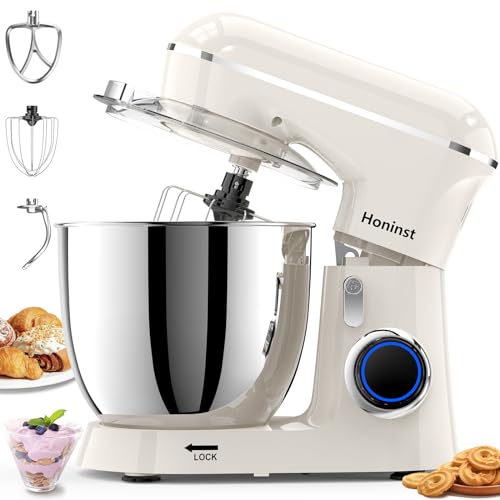
The review volume is real and it matters. When a no-name brand accumulates this many buyer accounts and the noise signal stays positive, something is working. One buyer who expected it to be loud based on the price was specifically surprised. That kind of expectation-reversed feedback shows up across multiple accounts, not just one outlier.
The aerodynamic chamber design claim - reducing resonance through airflow optimization - is manufacturer language, but the specification and the buyer pattern are consistent. At high speeds, some owners note slight vibration but not volume they'd describe as loud.
Two things to watch. The whisk attachment has a documented breakage pattern in long-term use. Hand-wash the whisk - dishwasher cycles fatigue the metal faster. Also: this is plastic construction at a price where all-metal isn't available. For most household baking, that's fine. For heavy weekly bread production, check the longevity reviews.
Available in multiple colors - the beige version is the most popular but performance is identical across colorways.
We earn a commission on purchases via these links. It does not change the price you pay or our ranking.
Martha Stewart 5.3QT Stand Mixer
No manufacturer dB figure. Buyers say quiet. The silicone beater edge is the differentiator.
Martha Stewart 5.3QT Stand Mixer
No manufacturer dB figure. Buyers say quiet. The silicone beater edge is the differentiator.
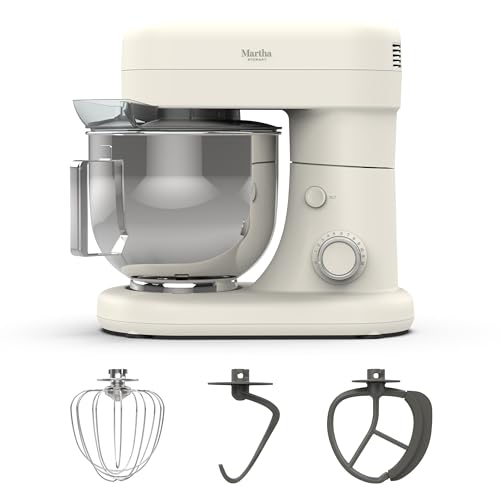
There's no manufacturer dB number here, which is fine. What there is: several buyers who specifically noted they stayed in the room while it ran without being bothered. One described making whipped cream and cookies with it running continuously. That's a real signal even without a spec.
The silicone-edged flat beater earns mention because it's not common at this price. It scrapes bowl sides while mixing, reducing the stop-and-scrape interruptions that most tilt-head designs require. If you make thick batters regularly, this saves real time.
The bowl is 5.3QT, not 6.5QT like most competitors here. For a household of one or two people, that's the right size. For large-batch bakers - 8+ dozen cookies, four loaves at once - the capacity gap matters. At $149.99 it's $20 above the $129 cluster; the silicone beater is doing that work.
We earn a commission on purchases via these links. It does not change the price you pay or our ranking.
CEBORY 3-IN-1 Stand Mixer
Solid performer. One buyer flagged it as a little loud - honest signal for a noise page.
CEBORY 3-IN-1 Stand Mixer
Solid performer. One buyer flagged it as a little loud - honest signal for a noise page.
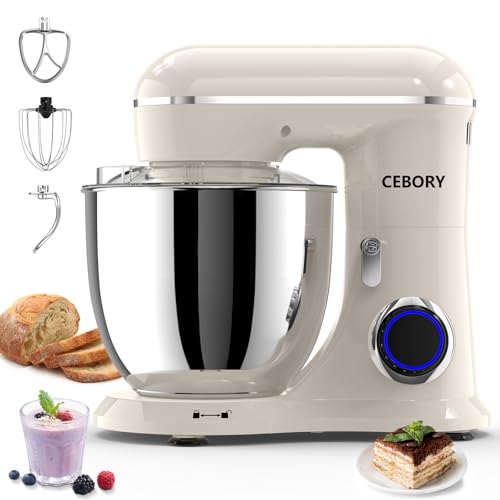
CEBORY makes a capable mid-range mixer. Buyers praise its performance on cakes and cookies, appreciate the compact footprint, and find it easy to clean. On a page focused on noise, the honest answer is that at least one buyer described it as a little loud. No dB spec means nothing to compare against.
The light weight is a genuine practical advantage - at around 10 pounds, you can pull it out of a cabinet and put it away without overthinking it. Buyers who explicitly didn't want a counter-permanent appliance respond well to this.
If your priority is quiet and you're comparing this to the Aifeel or Honinst, the noise gap is uncertain but real. No buyer on this mixer specifically praised quiet operation. If quiet isn't your top criterion and you want a capable performer at $129.99, this is a reasonable choice.
We earn a commission on purchases via these links. It does not change the price you pay or our ranking.
Budget Entry: $119 Starting Point
Ecunafix is the cheapest on this list and, unusually, publishes an honest dB range rather than cherry-picking the quietest speed. If you bake occasionally and quiet isn't critical, this is the option.
Best Budget Pick Ecunafix 6.5QT Stand Mixer
Honest 60-72 dB range. No buyer noise signal either way. Does the job.
Ecunafix 6.5QT Stand Mixer
Honest 60-72 dB range. No buyer noise signal either way. Does the job.
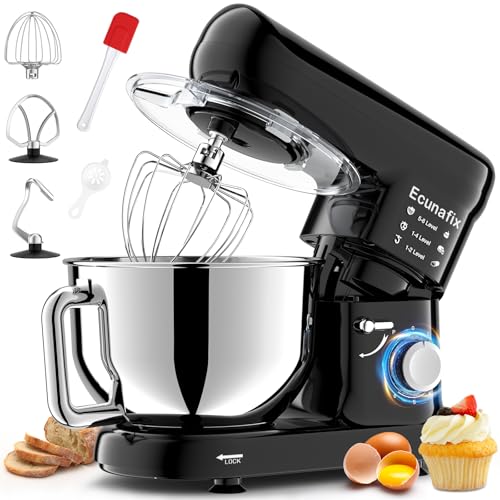
The 60-72 dB spec range is, weirdly, more honest than most competitor listings. Most manufacturers publish a single number measured at their quietest speed. Publishing a range that includes the high-speed end is rare. The 72 dB ceiling is real - at full speed, this runs louder than the DC-motor units.
At $119.99 it's the cheapest mixer in this roundup by $10. The value case is real but modest - $10 savings over the Honinst is not a compelling reason to accept higher potential noise. The case for Ecunafix is if you bake occasionally, don't care about noise specifically, and want to spend as little as possible.
Buyers find it performs well for cakes and cookies. The auto-stop when the tilt head raises is a practical safety feature. No buyer specifically flagged noise complaints, but no buyer flagged quiet praise either.
We earn a commission on purchases via these links. It does not change the price you pay or our ranking.
High-Capacity: When You Need the Volume
The Bosch Universal Plus handles 14 loaves at once. It is also the loudest machine here. Included because some buyers genuinely need the capacity and should know the noise tradeoff before spending $449.
Skip This One Bosch Universal Plus 6.5QT
Buyers say louder than KitchenAid at bread-dough speeds. The capacity is real; the quiet is not.
Bosch Universal Plus 6.5QT
Buyers say louder than KitchenAid at bread-dough speeds. The capacity is real; the quiet is not.
The Bosch Universal Plus is here to be honest about what high-capacity mixing costs in noise terms. It handles 14 loaves of bread dough at once. It is also louder than KitchenAid at bread-dough speeds, which is saying something. Multiple buyers confirm both facts.
The bottom-drive design is fundamentally different from tilt-head mixers. There's no tilt mechanism - ingredients go in from the top, and the bowl doesn't lift. This takes adjustment if you've used tilt-head machines your whole baking life. The splash ring and access opening help, but the workflow is different.
At $449, the price is justified for high-volume home bakers who run it weekly for large batches. Cottage bakers scaling up, serious bread enthusiasts making multiple loaves simultaneously - these are the right buyers. If you're making a batch of cookies on weekends, this machine is overkill and loud besides. The plastic whip drive has a documented breakage pattern. Hand-wash it.
We earn a commission on purchases via these links. It does not change the price you pay or our ranking.
Compare all 7 mixers
dB figures shown are manufacturer claims measured under controlled conditions. Real noise at bread-dough loads runs higher. Use this table for relative comparison, not absolute quiet measurement.
| Product | dB | Motor Type | Price | Badge | Verdict |
|---|---|---|---|---|---|
| Aifeel 700W DC Stand Mixer | 55 dB | DC Motor | $130 | Quietest Overall | DC motor, manufacturer spec. Buyers confirm quiet at moderate speeds. |
| Kourice 6.5QT Stand Mixer | 55 dB | DC Motor | $130 | Most Interesting Engineering | Bold magnetic levitation claim. Thin data. Early buyers positive on noise. |
| Honinst 6.5QT Stand Mixer | <60 dB | Mid-Range | $130 | Best for Most Kitchens | Largest buyer pool here. Reports consistently quiet even at high speeds. |
| Martha Stewart 5.3QT Stand Mixer | No spec | Mid-Range | $150 | No dB spec. Buyers say quiet. Smaller 5.3QT bowl suits 1-2 person households. | |
| CEBORY 3-IN-1 Stand Mixer | No spec | Mid-Range | $130 | One buyer said "a little loud." No dB spec. Solid performer otherwise. | |
| Ecunafix 6.5QT Stand Mixer | 60-72 dB | Budget | $120 | Best Budget Pick | Honest 60-72 dB range. No buyer noise signal. Cheapest on the list. |
| Bosch Universal Plus | Loud | Workhorse | $449 | Skip This One | Buyers say louder than KitchenAid. Not here for quiet. Here for capacity. |
Why stand mixer noise claims are mostly fiction
How manufacturers measure dB - and why it doesn't match your kitchen
Every stand mixer dB spec is measured at the quietest possible conditions: lowest or mid-range speed, no dough in the bowl, measured at a standardized distance (usually 1 meter). That's a real measurement. It's just not a representative one.
Real baking noise is different. When you're kneading bread dough at speed 2, the motor works against real resistance. Vibration increases. Gear mesh noise increases. Bowl resonance increases. A mixer rated at 58 dB can easily hit 72-75 dB during a full batch of whole-wheat bread dough. The 55 dB unit with a DC motor will run meaningfully quieter at that load than the 60 dB unit with an AC motor. The spec sheet comparison understates this gap.
DC motors: the reliable quiet shortcut
AC motors run on alternating current that pulses 60 times per second. That electrical chop creates motor vibration, which creates mechanical noise. DC motors receive smooth, regulated power from an internal converter. The rotor turns more evenly. Less vibration means less noise - typically 5-10 dB quieter at equivalent speeds and loads compared to AC motors of similar wattage.
Higher wattage does not mean louder. A 700W DC motor (Aifeel) runs quieter than a 350W AC motor at the same load. The spec that matters is motor type, not wattage. Filtering to DC-motor units is the fastest way to narrow toward genuinely quiet options.
Stand mixer noise by task - a real-world reference
Bearing quality and noise over time
A mixer that sounds quiet at purchase can run noticeably louder after 12-24 months of regular use. The cause is bearing wear. Budget bearings have more mechanical play; that play increases as metal surfaces wear against each other. The noise creeps up gradually, so buyers often don't notice until it's clearly louder than new.
Reading buyer reviews from 6+ months of ownership gives a more accurate long-term noise picture than reviews written in the first week. Reviews that specifically say "still runs quiet after a year" are more informative than "it's so quiet!" written after the first batch of cookies.
Common questions
What decibel level is a stand mixer?
The typical range is 55-82 dB depending on motor type, speed, and load. Most manufacturer claims are measured at quiet conditions - low speed, empty bowl. Real baking noise at bread-dough speed runs 10-20 dB higher for average units. DC-motor mixers can stay below 65 dB at moderate loads; AC-motor units at full bread-dough load often reach 75-82 dB.
Are DC motor stand mixers actually quieter than AC?
Yes, measurably. DC motors receive smooth regulated power; AC motors deal with alternating current that pulses 60 times per second. That pulse creates motor vibration, which creates noise. At equivalent speeds and loads, DC motors run 5-10 dB quieter. This is why the Aifeel 700W DC unit claims 55 dB while many cheaper AC units claim 60-72 dB - the motor architecture is doing real acoustic work.
Why does my stand mixer get louder when kneading bread dough?
Load. The motor works harder against dense, resistant dough, generating more heat, more vibration, more gear mesh noise, and more bowl resonance. This is normal and expected - it's why single-speed dB specs measured at light load are misleading. A mixer rated at 58 dB can realistically hit 72-75 dB at full bread-dough load. For noise-sensitive situations, test at the actual task you'll be doing most, not the lightest whipping speed.
Do stand mixers get louder over time?
Often, yes. Bearing wear is the main cause. Budget bearings have more initial mechanical play, and that play increases as metal surfaces wear together. The noise increase is gradual - typically noticeable after 12-24 months of regular use. Reading buyer reviews from 6+ months of ownership gives a more accurate long-term noise picture than first-week impressions.
Is KitchenAid Artisan louder than budget DC-motor mixers?
At bread-dough speeds, yes. The KitchenAid Artisan uses an AC motor and a bowl-lift or tilt-head design that has been reported by multiple buyers at 75-80 dB during heavy kneading. DC-motor units in the $129 range can stay below 65 dB at the same load. The KitchenAid earns its premium on build quality, attachment ecosystem, and longevity - not on noise. If quiet is the primary criterion, DC-motor alternatives outperform it at a fraction of the price.