Hand Mixers · 2026 edition
Quiet hand mixers: what the specs won't tell you
Hand mixer marketing is a specific kind of confusing. "500W DC motor." "Soft-start technology." "Ultra-quiet operation." These sound like engineering credentials. What they don't tell you is how loud the thing actually is at 6am in a quiet house, or whether your neighbors will hear it through the wall. Finding the quietest hand mixers shouldn't require reading between marketing lines.
No manufacturer publishes verified dB specs for hand mixers. Consumer Reports measures them with an actual meter, but the numbers stay behind a paywall. What we have is buyer feedback from people who specifically mentioned noise: the ones baking before the house wakes up, the apartment dwellers, the parents mixing during nap time. Three myths first. Then five mixers with honest noise assessments. Then a buying guide on what actually drives the noise in your kitchen.
Three Things Hand Mixer Marketing Gets Wrong
The myths are worth clearing up before the products. They're the reason buyers end up surprised when a "quiet" mixer turns out to be anything but.
Myth 1 More watts equals a louder mixer
Wattage describes power headroom, not noise. A well-built 300W DC motor can be quieter by several decibels than a cheap 500W brushed motor. The engineering matters more than the number on the spec sheet: tolerances, damping, motor type.
Budget mixers often lead with high wattage claims precisely because they can't compete on build quality. 500W sounds like a specification. It isn't a noise specification.
Myth 2 KitchenAid is the quietest option
KitchenAid is the most consistent option. Noise-wise, it's middle of the pack. Buyers who've owned one for years consistently describe the same sound in year four as year one. That's a real and underrated virtue, because cheap mixers get louder as gearboxes wear.
But KitchenAid doesn't have the noise-specific engineering (DC motor, soft-start) that newer brands do. The name recognition is doing a lot of heavy lifting here.
Myth 3 "Soft start" means the mixer runs quietly
Soft start prevents the motor surge at startup, where most of the initial spike noise comes from. That's a genuine improvement. But the mixer reaches full operating speed within seconds, and that's where it runs for the rest of the cycle.
Soft start improves the first two seconds. What happens after depends on motor quality and gearbox construction. It matters, just not as much as the marketing implies.
All 5 Picks at a Glance
No manufacturer-verified dB specs exist for hand mixers as a category. The editorial tiers below reflect buyer-reported noise experience, not lab measurements. Sorted from quietest to noisiest by editorial judgment.
| Product | dB | Motor Type | Price | Badge | Verdict |
|---|---|---|---|---|---|
| Lord Eagle 9-Speed Digital Hand Mixer Electric Handheld | Quietest | DC Motor | $57 | Quietest Overall | DC motor + soft-start: quietest combination in this set |
| Yomelo 9-Speed Digital Hand Mixer Electric | Quiet | DC Motor | $33 | Claims under 60 dB from maker; buyers say noticeably quiet at low speeds | |
| KitchenAid 5-Speed Ultra Power Hand Mixer | Quiet | Established Brand | $60 | Predictable and manageable; not the quietest, but won't get worse | |
| Lord Eagle Hand Mixer Electric Handheld 400W | Quiet | Budget | $30 | Best Budget Pick | Quiet for the speed; owners say it punches above its $30 price point |
| GELANGS-400W Hand Mixer with Turbo Boost - 5-Speed | Average | Copper Motor | $30 | Adequate noise; copper motor build is the story, not silence |
DC Motor Hand Mixers
DC motors run smoother than brush motors at equivalent speeds. That difference is audible. Both models here use DC motors and soft-start - the combination buyers consistently describe as the quietest in the category.
Quietest Overall Lord Eagle 9-Speed Digital Hand Mixer
DC motor plus soft-start: the quietest combination in this group by buyer consensus.
Lord Eagle 9-Speed Digital Hand Mixer
DC motor plus soft-start: the quietest combination in this group by buyer consensus.
Buyers mixing early-morning pancake batter describe the soft-start as genuinely working. No sudden motor roar, no waking the household.
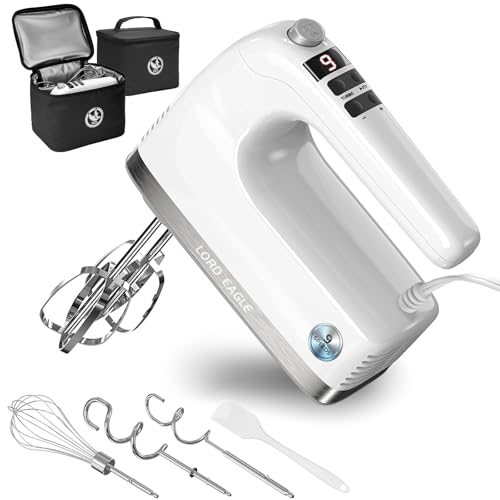
The two things that make this mixer quiet aren't marketing. DC motors deliver smoother torque than brush motors under the same load, which translates to less mechanical whine at speed. Soft-start ramps the motor gradually rather than surging to full power on the first revolution. That surge is where most of the startup noise comes from. When the motor builds slowly, the sound builds with it, no spike.
Buyers who bake at 6am before anyone else is up describe both effects as real. The motor sound is consistently called lower in pitch and smoother than budget mixers they'd owned before. One buyer who switched from a heavier mixer specifically mentioned that 1.76 pounds makes long baking sessions less tiring. Weight reduction and vibration reduction tend to travel together.
Build quality feedback is divided. Some buyers find it premium for the price; at least one found the construction disappointing. Don't buy it expecting a KitchenAid-grade shell. The noise performance holds up; the physical quality is less certain. The storage bag (not a snap-on case) is either a thoughtful inclusion or a nuisance, depending on how you organize your kitchen drawers.
We earn a commission on purchases via these links. It does not change the price you pay or our ranking.
Yomelo 9-Speed Digital Hand Mixer
Claims under 60 dB from maker; buyers say noticeably quiet at low speeds.
Yomelo 9-Speed Digital Hand Mixer
Claims under 60 dB from maker; buyers say noticeably quiet at low speeds.
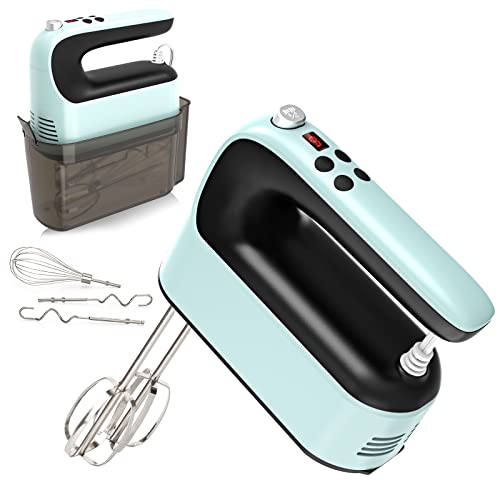
The manufacturer claims under 60 dB. That's the first specific number anyone has put on a hand mixer in this group, and 60 dB is genuinely quiet for the category, about conversation level. State it, then flag it: this is a manufacturer claim, not an independently verified measurement. Whether it achieves that at real speeds in a real kitchen is unknown.
400W DC motor. Same motor type as the Lord Eagle 9-speed, lower wattage. DC motors are smoother at equivalent loads, so the fundamental advantage is real. Buyers who've used it on light to medium tasks describe the sound as unobtrusive. One buyer is honest about it: it isn't quiet at high speed. That's the accurate picture. The 9-speed range lets you keep most tasks at lower settings, which makes a real practical difference even if the top end is loud.
One quality concern worth stating directly: multiple buyers report the cord snapping at the strain relief point. That's a safety issue, not a minor annoyance. Mind where the cord bends during use. The noise performance is interesting; the durability concern is not something to bury in the fine print.
We earn a commission on purchases via these links. It does not change the price you pay or our ranking.
Established Brands with Track Records
Noise data from a few dozen buyers tells you where a product starts. Tens of thousands of owners over multiple years tells you where it stays. These two have the depth to know.
KitchenAid 5-Speed Ultra Power Hand Mixer
Predictable and manageable; not the quietest, but won't get worse over time.
KitchenAid 5-Speed Ultra Power Hand Mixer
Predictable and manageable; not the quietest, but won't get worse over time.
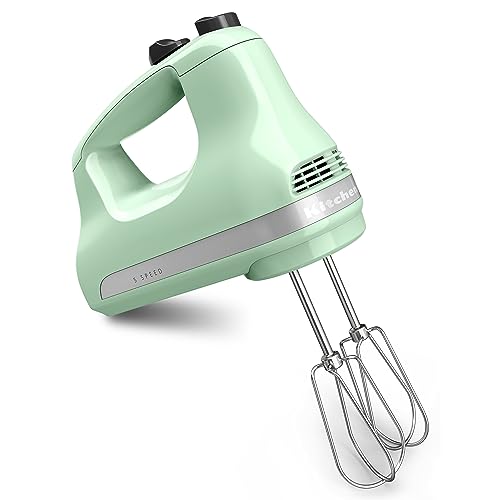
KitchenAid's noise story is about consistency, not quiet. Buyers who've owned this for three, four, five years describe the same noise floor in year four as year one. That's not nothing. Most cheap mixers develop a rougher, louder quality as gear grease dries out and gear tolerances wear in. The KitchenAid doesn't drift, and that matters more than a first-day reading for buyers who keep appliances.
At $59.99, this costs the same as the Lord Eagle 9-speed, which has stronger noise credentials and more speed steps. The honest tradeoff: you're paying for brand trust and long-term predictability, not for leading noise performance. If the reliability of an established name matters to you, that's a legitimate reason to choose it. If quiet is the priority, the DC motor alternatives get there more convincingly.
We earn a commission on purchases via these links. It does not change the price you pay or our ranking.
Best Budget Pick Lord Eagle 5-Speed Hand Mixer
Quiet for the speed - owners say it punches above its $30 price point.
Lord Eagle 5-Speed Hand Mixer
Quiet for the speed - owners say it punches above its $30 price point.
At $30 with a large owner data set behind it, this is a legitimate recommendation. Not a filler pick.
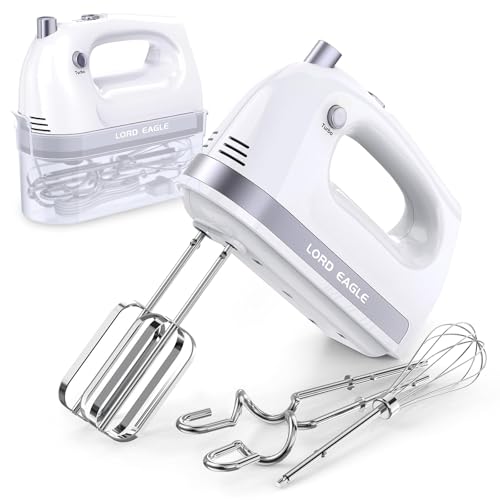
"Quiet for the speed" is how buyers describe it, and that's exactly the right frame. Not whisper-quiet. Appropriate noise for the power output at $30. That's what you want.
- 400W copper motor. Copper winding provides better heat dissipation than copper-clad aluminum alternatives, which typically means longer motor life and more consistent performance over time.
- Large owner data set. At this depth of buyer feedback, the overall picture is reliable. Noise isn't a problem buyers are writing about, which is informative in itself.
- Speed 1 caveat. Some buyers find the lowest speed faster than expected. If very delicate whipped cream or egg white work at the absolute slowest setting matters to you, note it before buying.
Against the Lord Eagle 9-speed at $56.99: the extra $27 probably does buy meaningfully more quiet (DC motor, soft-start, 9 speed steps instead of 5). But for most home bakers - birthday cakes, cookie dough, weekend pancakes - the noise difference won't be dramatic enough to notice. The $30 version is a genuine recommendation.
We earn a commission on purchases via these links. It does not change the price you pay or our ranking.
Worth Considering
One mixer with an interesting copper motor build and adequate noise performance. Thin review data - treat it as a tentative positive, not a confirmation.
GELANGS 400W Copper Motor Hand Mixer
Adequate noise; copper motor build is the story, not silence.
GELANGS 400W Copper Motor Hand Mixer
Adequate noise; copper motor build is the story, not silence.
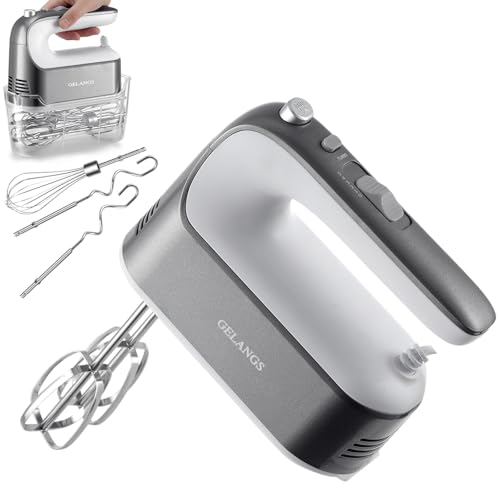
The listing specifies all-copper motor winding, not copper-clad aluminum. That's a specific claim worth noting: better heat management and potentially smoother motor operation are the theoretical benefits of genuine copper windings.
One experienced baker with decades of hand mixer history reports it runs smoother and less loudly than previous mixers they've owned. Interesting signal. Also one person, one use case, from a thin pool of buyer feedback. Everything here is preliminary. The storage case has a fit issue for some buyers - doesn't click closed properly. The turbo button adds burst power above the 5 speeds, which is useful for thick batters but isn't a noise-reduction feature.
If the copper motor claim appeals and you're willing to buy with thin supporting data, this is a reasonable gamble. At the review depth it currently has, it doesn't belong higher on the list.
We earn a commission on purchases via these links. It does not change the price you pay or our ranking.
What Actually Drives Hand Mixer Noise
The nerdy part. If you've already found your mixer above, skip this. If you want to understand why some mixers are louder than they should be, read on.
The dB reality check for this category
Typical hand mixer range: 65-85 dB. Most consumer models land in the 70-80 dB band at medium-to-high speed. Under 74 dB counts as low-noise for the category.
For context: 70 dB is a vacuum cleaner at a distance. 80 dB is a busy restaurant. That's not a small gap. At 85 dB, where some budget models peak at high speed, you're approaching NIOSH's threshold for limiting prolonged exposure. Not immediately dangerous, but not a comfortable baking environment.
No industry standard exists for "quiet" labeling in this category. "Whisper-quiet" and "ultra-silent" are unregulated marketing terms. If no dB number appears in the listing, treat the noise claim as marketing.
DC motors vs. brush motors
DC motors deliver smoother torque curves. Less mechanical noise at equivalent loads. This is physics, not a marketing claim, but even DC motors vary in quality. Most consumer hand mixers use brushed AC motors. DC motors are appearing at budget price points ($30-60, as in this set), but brushless DC (the quietest type) remains rare in hand mixers as of 2025.
Beater type affects noise more than most buyers realize
- Rubber-coated or silicone beaters reduce the metal-on-bowl clatter that can dominate over motor noise at low speeds.
- Balloon whisks generate more aerodynamic noise than flat beaters at the same RPM.
- Dough hooks are the loudest attachment. Stiff dough loads the motor heavily, which pushes RPMs and noise up significantly.
- Bowl material matters. Metal bowls resonate and amplify; silicone and plastic absorb vibration.
Speed count beats wattage as the useful buying spec
More speed steps mean you can accomplish tasks at lower RPMs. That's less noise in practice. A 9-speed model isn't louder because it goes faster - it's often quieter in use because you stay at speed 3 for the task that a 5-speed model has to run at speed 4.
Noise increases over time
Gear grease dries out. Gear surfaces wear. Both increase mechanical friction and noise. A mixer that's acceptably quiet at purchase can be noticeably louder after two or three years. Some models can be disassembled and re-greased; many are sealed units.
This is why the KitchenAid's consistency argument is worth taking seriously. A mixer that starts at 75 dB and stays there is better than one that starts at 70 dB and climbs to 82 dB by year three. If you keep appliances long-term, the starting point is less important than the trajectory.
Frequently Asked Questions
How many decibels does a hand mixer produce?
Typical range is 65-85 dB. Most consumer models land in the 70-80 dB band at medium-to-high speed. Under 74 dB counts as low-noise for the category. No standard exists for "quiet" labeling, so manufacturer claims without actual dB numbers are unverifiable. If the box says "ultra-quiet" and no number follows, that's marketing.
Is a DC motor hand mixer actually quieter?
Generally yes. DC motors deliver smoother torque with less mechanical noise at equivalent speeds. The difference is real but modest, and motor quality still varies within DC models. It's an advantage, not a guarantee. The Lord Eagle 9-speed and Yomelo both use DC motors; buyers describe both as noticeably smoother-sounding than typical budget mixers.
Can I use a hand mixer in an apartment without disturbing neighbors?
At low speeds for short sessions, probably. At high speed with dough hooks, it's a different story. A typical hand mixer at medium speed runs around 75 dB, which is audible through walls but unlikely to reach complaint-level in a reasonably insulated building. Most city noise ordinances kick in after 10pm; early morning baking at medium speed is generally fine. High-speed creaming during the baby's nap is not.
Does soft-start make a hand mixer quieter?
Soft-start reduces the spike noise at startup, the motor surge when you first power on. It doesn't change the operating noise at full speed. Genuinely useful, but only for the first one or two seconds of operation. The noise you live with during baking is the running noise, not the startup spike.
Why does my hand mixer get louder over time?
Gear grease dries out and gear surfaces wear. Both increase mechanical friction and noise. If a previously quiet mixer is getting louder, it's usually the gearbox. Some models can be disassembled and re-greased; many are sealed units where the noise increase is permanent. A grinding or rougher sound that wasn't there before is the gearbox, not a motor problem.