Weed Eaters · 2026 edition
The quietest weed eaters, according to actual buyers
Go find the decibel spec on any weed eater listing. We'll wait. There isn't one. The entire category sells "quiet" as an adjective, never as a number, which makes hunting for the quietest weed eater an exercise in reading between the lines. So that's what we did: motor architecture, head RPM, and every buyer noise report we could find.
If you time yard work around nap schedules, close neighbors, or a corner lot with three fences, this sorting matters. Eight products went in, six survived. Two battery machines with real quiet evidence behind them. Two we're openly unsure about, including one whose lone noise report amounts to: bring earplugs. And the sleeper: a $13 spool of trimmer line that quiets the machine you already own. No competitor page will tell you about that one.
All 6 Picks at a Glance
No product here has a published dB rating, because no consumer trimmer does. The pill column shows our editorial noise tier and where each claim actually comes from: buyer testimony, motor architecture, or a manufacturer number we can't verify.
| Product | dB | Type | Price | Badge | Verdict |
|---|---|---|---|---|---|
| BLACK+DECKER 20V MAX String Trimmer and Edger 2 in 1 | Buyer-quiet | Battery string | $62 | Quietest Overall | Low-RPM drive, deep buyer pool, quiet reports across nine years. |
| EGO POWER+ String Trimmer | Brushless | Battery string | $160 | Best for Big Yards | Power pick. Brushless 56V; buyers gripe about line feed, not noise. |
| 20000 RPM Brushless Electric Weed Wacker Cordless | No spec | Battery blade | $140 | Blade cutter, low vibration claims, review pool too thin and too perfect. | |
| HEINPRO Cordless String Trimmer Compatible with Dewalt 20V MAX Battery | Buyer-loud | Battery string | $50 | Loudest on the List | The one noise report in its pool says earplug-loud. Cheap for a reason. |
| Husqvarna Titanium Force 0.095 | 50% quieter (mfr) | Trimmer line | $13 | Cheapest Noise Fix | Dimpled line, decades of buyers confirming the quiet. Cheapest fix here. |
| Efrozen Weed Eater String | Claim vs buyer | Trimmer line | $19 | Claims a 30-50% noise cut; the buyer who tested it heard no difference. |
The quiet machines
Battery drive and low head RPM are what quiet actually looks like in this category. These two have the buyer evidence to back it, and they solve different yards.
Quietest Overall BLACK+DECKER LST300 20V String Trimmer
Low-RPM drive, deep buyer pool, quiet reports across nine years.
BLACK+DECKER LST300 20V String Trimmer
Low-RPM drive, deep buyer pool, quiet reports across nine years.
Buyers keep describing the same three things: starts instantly, weighs nothing, runs quiet.
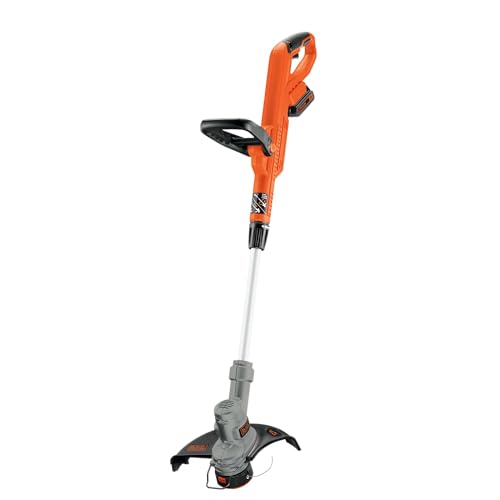
6,200 RPM. Remember that number, because the budget trimmers further down this page spin their heads at 19,000 to 20,000. Line-tip speed is what makes a trimmer scream, and the LST300's POWERDRIVE transmission gets its cutting force from torque instead of raw head speed. That's the mechanical reason this thing runs quiet. It's not padding. It's not luck.
Black+Decker actually puts "quiet and easy to start" on the spec sheet, which is usually the kind of claim we roll our eyes at. Here the buyers back it up. One owner in her seventies, working a rural lot full of weeds she describes like an invading army, calls it a deceptive beast: light enough to swing for an hour, strong enough to win. Another recommends it specifically as the escape hatch from gas noise and gas weight. A third reports no vibration at all, with instant push-button starts every time.
The honest caveat is runtime. Push it hard against thick growth and some buyers see the battery fold in 10 to 15 minutes. And one long-time fan offers durability advice worth repeating: place it in the truck, don't throw it. For a small-to-medium yard with close neighbors, this is the pick. At $62, it isn't close.
We earn a commission on purchases via these links. It does not change the price you pay or our ranking.
Best for Big Yards EGO Power+ ST1502SA 15" String Trimmer
Power pick. Brushless 56V; buyers gripe about line feed, not noise.
EGO Power+ ST1502SA 15" String Trimmer
Power pick. Brushless 56V; buyers gripe about line feed, not noise.
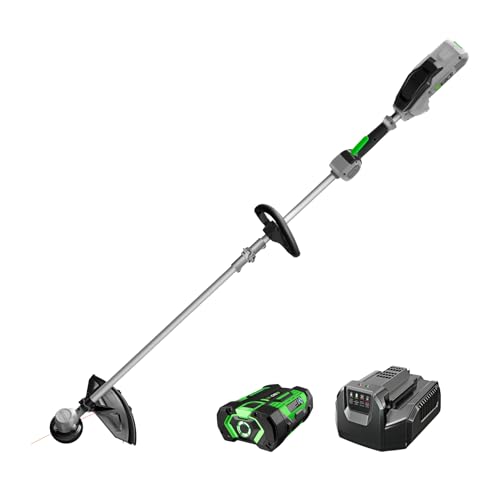
One buyer wrote what might be the most thorough unboxing account we've ever read for a trimmer. Charger behavior, light sequences, minute-by-minute charge times. His only noise complaint in the whole saga? The charger's cooling fan, which hummed loudly enough that he briefly feared it was burning out. The tool itself passed without a single remark. When the charger is the loud part of your kit, the trimmer is doing something right.
- 56V brushless motor: quiet is a byproduct of the architecture, not a sticker
- 15-inch swath and variable speed for long sessions on big lots
- Rapid-Reload head: twist to load new line, no spool surgery
- 50-minute charge on the included 2.5Ah battery
- Independent testers repeatedly hand EGO the quiet crown in this class
Where buyers do push back, it's not about sound. The line-feed system is the recurring gripe: string that won't advance without coaxing. Weight gets mixed marks too. Some find it light, but gas veterans expecting a featherweight don't get one. If your yard is measured in acres rather than fence panels, the extra hundred dollars over the Black+Decker buys you the muscle to finish it, without waking the street.
We earn a commission on purchases via these links. It does not change the price you pay or our ranking.
Two we're not sold on
One has a small, suspiciously glowing review pool. The other collected the category's only earplug-level noise complaint. Both stay on the page, because pretending they don't exist helps nobody.
Lemolifys 4-in-1 Wheeled Blade Cutter
Blade cutter, low vibration claims, review pool too thin and too perfect.
Lemolifys 4-in-1 Wheeled Blade Cutter
Blade cutter, low vibration claims, review pool too thin and too perfect.
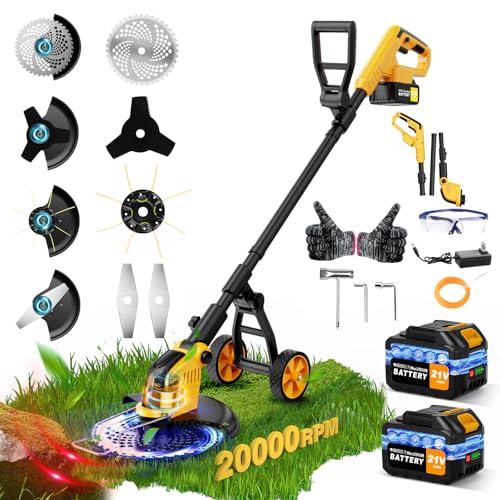
We wanted to love this one. About four pounds, wheels, a swivel head, and no string to feed, because it cuts with blades instead. Blades change the sound character entirely: none of the line-whip whine, just motor and contact noise. The few noise-adjacent reports say the right things. Low vibration. High motor speed but not too loud. Push-button starts.
So why is it down here? The review pool is small, uniformly glowing, and reads like it was written for the brand rather than by neighbors. One entry details unboxing the thing in a February snowstorm. Maybe every word is true; we can't verify any of it, and a tiny pool of flawless praise from an unknown brand is exactly the pattern we're paid to distrust. Real-world runtime lands around 20 to 30 minutes per battery on hard growth, and it ships two batteries because it needs them.
Verdict: plausible, unproven. If the blade format solves a real problem in your yard, it's worth a try from a seller with easy returns. Buying it purely for quiet is a leap of faith we won't make for you.
We earn a commission on purchases via these links. It does not change the price you pay or our ranking.
Loudest on the List HEINPRO Cordless Trimmer (DeWalt-Compatible)
The one noise report in its pool says earplug-loud. Cheap for a reason.
HEINPRO Cordless Trimmer (DeWalt-Compatible)
The one noise report in its pool says earplug-loud. Cheap for a reason.
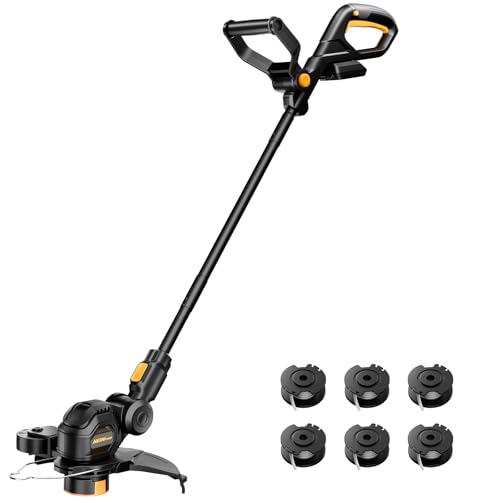
$50, tool only, runs on the DeWalt 20V packs you may already own. One buyer even ran it on Makita batteries. Owners like the price, the 4.2-pound weight, and the wheeled edging trick. Here's the problem: the single noise-specific report in its entire review pool calls it seriously loud and advises earplugs. One account, sure. But it's the only noise account there is, nothing contradicts it, and a high-RPM budget motor with zero acoustic design is exactly the machine that earns it. This card exists to make one point: battery does not mean quiet. If noise is why you're on this page, skip it.
We earn a commission on purchases via these links. It does not change the price you pay or our ranking.
The $13 noise fix: quiet trimmer line
Line profile changes trimmer noise more than most buyers realize. One line here has buyer-backed quiet claims going back two decades. The other's quiet claim got flatly contradicted by the one buyer who checked.
Cheapest Noise Fix Husqvarna Titanium Force .095" Trimmer Line
Dimpled line, decades of buyers confirming the quiet. Cheapest fix here.
Husqvarna Titanium Force .095" Trimmer Line
Dimpled line, decades of buyers confirming the quiet. Cheapest fix here.
A twenty-year repeat buyer praises two things above all: how long it lasts and how little sound it makes.
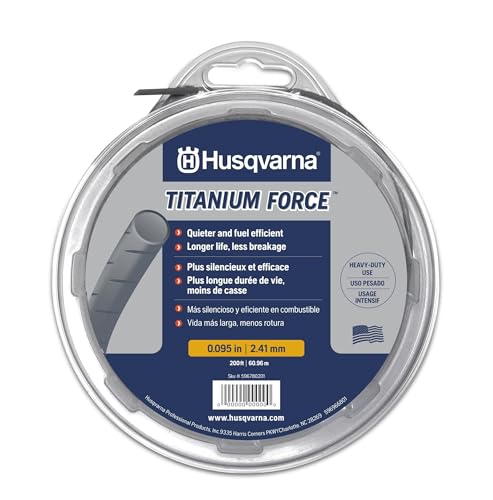
Why is a spool of string on a weed eater page? Because a big share of trimmer noise at your ear isn't the motor. It's the line itself tearing through air thousands of times a minute. Change the line's surface and you change the sound. This one is round with a dimpled, undulated surface, like a golf ball, and Husqvarna claims the patented profile cuts noise by 50 percent.
The claim: 50% noise reduction from the patented dimpled surface. A manufacturer number with no test standard attached, so treat the magnitude with suspicion.
The corroboration: a buyer who has run this line for two decades praises the lack of sound and how rarely he has to advance it. Another switched from square line and reports lower noise, cleaner cuts, and fewer snap-offs against brick edging and chain-link fence.
Buyers confirm the direction, not the percentage, and that's enough. For $13 on a 140-foot spool, this is the cheapest noise reduction in lawn care. It fits any standard head that takes .095 line. One recurring gripe: the gray color is hard to see when you're threading it in the shade, so cut it an inch long.
We earn a commission on purchases via these links. It does not change the price you pay or our ranking.
efrozen Square Twist .105" Trimmer Line
Claims a 30-50% noise cut; the buyer who tested it heard no difference.
efrozen Square Twist .105" Trimmer Line
Claims a 30-50% noise cut; the buyer who tested it heard no difference.
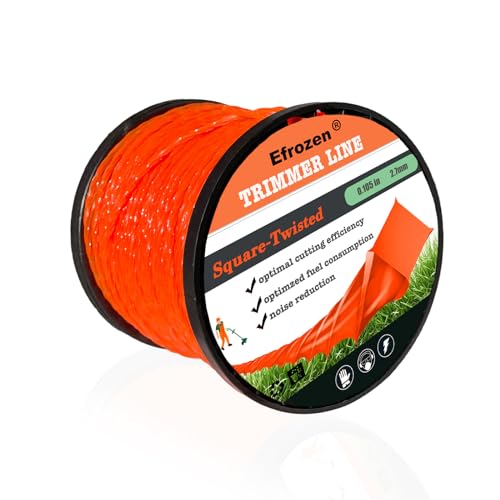
Can a square line be quiet? The physics says probably not. Square profiles are the loud family; their corners cut aggressively and churn the air doing it. Twisted profiles are the quiet compromise. This line is marketed as a "square twist" hybrid promising a 30 to 50 percent noise reduction, and the one buyer who actually paid attention, running it on his Husqvarna and Stihl machines, noticed no difference in noise at all.
What that same buyer did confirm is toughness. The durability praise around this line is consistent: it doesn't shred into fuzz, it survives fences and decorative rock, and the bright orange is easy to track while cutting. That's a genuinely good trimmer line. It's just not a quiet one. Buy it for toughness, not for your ears, and let the noise claim go where most noise claims in this category belong: in the bin.
We earn a commission on purchases via these links. It does not change the price you pay or our ranking.
How to Buy a Quiet Weed Eater
The nerdy part. If you found your pick above, you're done. If you want to know why the quiet ones are quiet, this is the ten-minute version.
Three numbers decide this whole category
Gas trimmers run roughly 90 to 100 dB at the operator's ear; safety guidance recommends hearing protection above 85 dBA; battery trimmers land roughly between 65 and 80. That's the entire gas-versus-battery argument in one sentence. On the logarithmic dB scale, a 15 to 30 dB drop means the battery machine sounds two to four times quieter to your ears, and the gap grows with distance. Your neighbor hears the difference even more than you do.
One independent tester measured their quietest battery trimmer at 81.5 dB at the ear, and still dinged it for an annoying high-pitched whine. Which tells you two things: even "quiet" trimmers aren't whisper machines up close, and pitch matters as much as the number. A low hum annoys nobody. A whine carries.
dB reference scale for trimmers
All figures are at the operator's ear, and none of them will appear on a product listing, because no standardized noise disclosure exists for consumer trimmers. Any dB number you see in a listing is marketing until proven otherwise.
The RPM arithmetic
A trimmer's scream is mostly line-tip speed. The line rips through air, and the faster the head spins, the more violently it rips. This is why the 6,200 RPM Black+Decker out-quiets budget machines spinning at 19,000 or 20,000 RPM. The budget maker's brochure calls high RPM "power". Your ears call it something else. Torque-based drives get the same grass cut at a third of the head speed.
Brushless vs brushed
Brushed motors drag physical contacts against a spinning commutator. That contact is friction, heat, and noise. Brushless motors switch electronically, removing the mechanical scrape entirely, which is why every serious quiet trimmer, including the EGO above, is brushless. If a listing doesn't say brushless, assume brushed, and assume louder.
The line is a noise part. Treat it like one.
Line profile families, from quiet to loud: round-dimpled, plain round, twisted, then square. Dimples break up the airflow that makes spinning line sing, corners churn it. Swapping square line for dimpled round is the only noise upgrade in lawn care that costs $13 and takes two minutes. It's also the first thing to try before replacing a trimmer you otherwise like.
How to read a category with no specs
Trust signals, in order:
- Motor architecture. Brushless beats brushed, low head RPM beats high. These are physical facts a marketing department can't restate.
- Buyer noise testimony. Owners who mention noise unprompted, in either direction, are the closest thing this category has to test data.
- Manufacturer claims. Last, and only when buyers corroborate the direction. A percentage with no test standard behind it is an adjective wearing a number's clothes.
Neighbor math and quiet hours
Noise ordinances almost always regulate by time of day, not by tool. In practice, a battery trimmer at 7 a.m. draws no complaints in most neighborhoods where a two-stroke at the same hour starts a feud. Sound also decays over distance, and the battery machine's lower starting point means it fades into background noise at the property line where gas is still clearly audible. Check your local rules; that part we can't do for you.
Frequently Asked Questions
How many decibels is a weed eater?
Gas models run roughly 90 to 100 dB at the operator's ear. Battery models run roughly 65 to 80 dB. No standardized disclosure exists for consumer trimmers, so treat any dB figure printed on a listing as marketing rather than a measurement.
Are battery weed eaters always quieter than gas?
Against gas, yes, across the whole category, and it isn't close. But battery is not a noise rating. A high-RPM budget unit on this very page collected a wear-earplugs report from a buyer. Motor architecture and head speed decide how quiet a battery trimmer actually is.
Do I need hearing protection with a battery trimmer?
For a short suburban trim, generally no. For long sessions at high speed, at-ear levels sit close to the 85 dBA line where safety guidance recommends protection, so cheap earmuffs are a smart habit for hour-long jobs.
Does trimmer line affect noise?
More than almost any spec. The line tearing through air is a large share of what you hear. Round-dimpled line is the quiet family, square is the loud one, and swapping profiles costs about $13. It's the cheapest noise change you can make to a trimmer you already own.
Can I run a weed eater during quiet hours?
Ordinances usually regulate time, not tool type. A battery trimmer early in the morning is far less likely to cause trouble than a gas one, both legally and socially, but the actual rules vary by town. Check yours before the 7 a.m. trim.