Wall Mount Fans · 2026 edition
Quietest Wall Mount Fans for 2026
Wall mount fans are one of the more honest product categories. The noise range from best to worst is narrow enough that a good table tells most of the story. What the table can't tell you is whether the oscillation mechanism will start clicking after six months, or whether the 45 dB claim was tested at medium speed in a padded room. That's what buyer accounts are for.
The box says 35 dB. The box is doing its job. Manufacturer dB claims are measured at medium speed at distance, often in conditions you will never experience in a bedroom or RV. High speed on that same 35 dB fan can easily hit 50 dB or more. The people who've been running these fans 24/7 for months tell a different story than the spec sheet, and that's the data we care about.
All 6 Picks: Sorted by Noise
Quietest first. Every product we recommend is here. This table is the fastest way to find your category, from bedroom-quiet remote models to budget pull-cord picks.
| Product | dB | Type | Price | Badge | Verdict |
|---|---|---|---|---|---|
| Koonie 8'' Wall Mount Fan | 35 dB | Small RV remote | $37 | Best for RV | RV-proven; wired remote stays put; 10W draw |
| VAGKRI Wall Mount Fan | 35 dB | 5-speed remote | $100 | Best for Bedrooms | Quietest verified by buyers; 5-blade, sleep mode, remote |
| Fansdrick 16" Wall Mounted Fan Indoor | 35 dB | DC + light | $110 | DC motor + light; quiet at low speeds; thin buyer data | |
| 8.5 | 40 dB | Compact remote | $44 | Best Compact Pick | Compact 8.5" with magnetic remote; oscillation vibrates |
| Hurricane 16" Supreme Oscillating Wall Mount Fan w/ 3 Quiet Speeds | 45 dB | Pull-cord budget | $36 | Oscillation complaints are a pattern; high speed is genuinely noisy | |
| Hurricane Classic Oscillating Wall Mount Fan w/ 3 Quite Speeds | No spec | Pull-cord budget | $35 | Reliable budget pull-cord; noisy on high, quiet enough at medium |
What the Table Can't Tell You
The dB number gets you in the ballpark. What it doesn't capture is the character of the noise. A 35 dB fan that ticks during oscillation wakes you up. A 40 dB fan running smoothly fades into background hum. Oscillation mechanisms are the known weak point across this category. Several models here have buyer reports of clicking, squealing, or vibration during rotation.
Motor type matters. DC motors are quieter at low speeds than AC motors, period. The physics: DC motors run at truly variable speeds with smoother torque delivery; AC motors step between fixed speeds and hum more. The Fansdrick DC model at $109.99 is the only DC option here. For everyone else, blade count becomes the noise lever. The VAGKRI 5-blade design moves the same airflow at lower RPM than a 3-blade fan, which means less mechanical noise and less wind noise. It's not marketing language. It's fan physics.
Mounting matters. A wall fan secured into a stud runs quietly. The same fan mounted to drywall with plastic anchors amplifies vibration. The wall becomes a resonator. Better anchors than whatever came in the box are the cheapest noise reduction available.
Top Picks: Deep-Dive
The three products that best solve specific use cases. These are the ones we'd buy.
Best for Bedrooms VAGKRI 16" 5-Speed Wall Mount Fan
Quietest verified by buyers; 5-blade, sleep mode, remote
VAGKRI 16" 5-Speed Wall Mount Fan
Quietest verified by buyers; 5-blade, sleep mode, remote
Five blades moving the same volume of air at lower RPM equals less mechanical noise and less wind noise. Buyers specifically credit this.
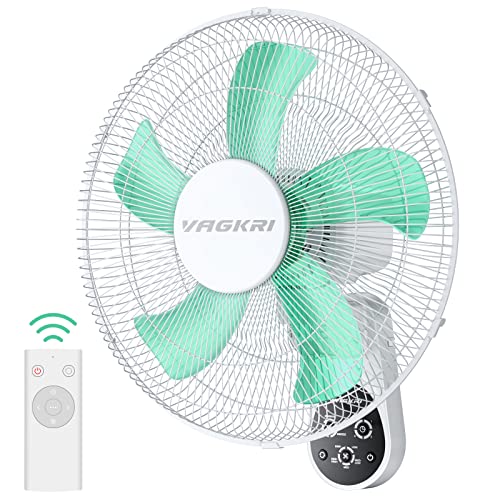
The 5-blade design is doing real work here. More blades moving the same volume of air at lower RPM equals less mechanical noise and less wind noise. One buyer notes getting the same airflow on speed 2 that would require speed 4 on a 3-blade fan. That difference is the entire value proposition.
Sleep features that actually work: sleep mode, timer, button indicator off so the screen goes dark, remote that works across the room. People run this in bedrooms specifically because the noise floor stays low enough to sleep through. One buyer used it to break up heat stratification in a 3-floor open home and says it kept upstairs rooms livable while reducing A/C bills. That's not a bedroom use case, but it validates the airflow claim.
A small periodic ticking during oscillation was noted by at least one buyer. Not loud, not constant, but worth mentioning. The wall anchors in the box are undersized for permanent installation. One buyer ditched the included hardware and used better anchors. At $99.99, this is 3x the price of the Hurricane pair. Not a budget fan. The genuine quiet pick for bedroom use.
We earn a commission on purchases via these links. It does not change the price you pay or our ranking.
Hurricane Classic 16" Wall Mount Fan
Reliable budget pull-cord; noisy on high, quiet enough at medium
Hurricane Classic 16" Wall Mount Fan
Reliable budget pull-cord; noisy on high, quiet enough at medium
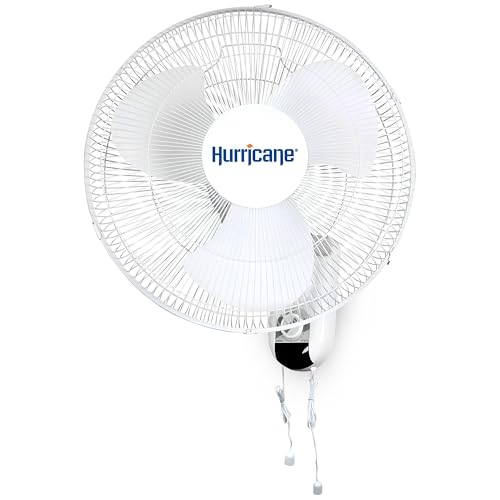
The Hurricane Classic has no dB spec. That's not an oversight. Hurricane doesn't publish one. What it does have is years of buyer data from people running it in greenhouses, grow tents, and living rooms at 23 hours a day. The verdict from that data is reliably good enough. Not quiet at high speed. Not silent at any speed. But not annoying enough to replace with something else after two years, which is what most of them get.
Buyers describe it as generating consistent background noise, which some specifically want for sleeping. White noise character. The longevity pattern is clear: roughly two years per unit at continuous use. Many buyers are on their second or third. That's not a product flaw. That's knowing what you're buying.
Some buyers report oscillation stops working over time. New-unit motor grease smell is real, mentioned by multiple buyers, fades over days. The plastic wall anchors in the box are undersized for permanent use. No remote. Pull cords only. Not suitable for bedroom at high speed. At $35.14, the most-reviewed wall fan at this price. The buyer who bought three of them over six years did so because it's good enough that you replace it when it dies rather than switching brands.
We earn a commission on purchases via these links. It does not change the price you pay or our ranking.
Best for RV Koonie 8" Wired Remote Wall Mount Fan
RV-proven; wired remote stays put; 10W draw
Koonie 8" Wired Remote Wall Mount Fan
RV-proven; wired remote stays put; 10W draw
In a moving vehicle, wireless remotes get lost. A remote you can mount in a fixed position next to your bunk and never have to hunt for is the right call for an RV.
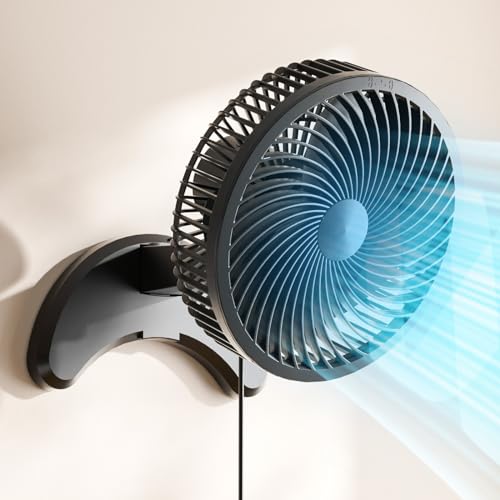
The wired corded remote (8.2 ft) is the defining feature for RV use. In a moving vehicle, wireless remotes get lost. A remote you can mount in a fixed position next to your bunk and never have to hunt for is the right call for an RV. No line-of-sight required, stays where you put it, never lost.
10W draw is the lowest in this set. On a 12V battery or small inverter, this matters. Memory feature means the fan remembers its last setting after power interruption. One buyer uses this with a smart plug and humidity sensor for automated bathroom ventilation. Two-month Arizona RV trip validation from a buyer who describes it as very quiet and still running like new is exactly the kind of confirmation this brand cares about.
Some buyers find it underpowered for larger spaces. Mounting adhesive is unreliable. Multiple buyers recommend screws for anything that moves or gets vibration. At $37.39, 8 inches, and genuinely RV-proven, this is the right call for a camper, trailer, or small boat cabin.
We earn a commission on purchases via these links. It does not change the price you pay or our ranking.
Budget Picks
Two pull-cord fans from the same brand. The Classic has years of buyer data behind it - thousands of installations, 23-hours-a-day use cases, and people who've bought it three times. The Supreme adds a dB spec and a dial, but pay attention to what buyers say about oscillation before buying.
Hurricane Classic 16" Wall Mount Fan
Reliable budget pull-cord; noisy on high, quiet enough at medium
Hurricane Classic 16" Wall Mount Fan
Reliable budget pull-cord; noisy on high, quiet enough at medium
Most-reviewed wall fan at this price. The buyer who bought three of them over six years is the story, not because the fan lasts forever, but because it's good enough that you replace it when it dies rather than switching brands.
No manufacturer dB spec exists. Be upfront about this rather than papering over it. Buyers describe white noise character, which some specifically want for sleeping. Longevity pattern is clear: roughly two years per unit at continuous use. Many buyers are on their second or third.
Oscillation stops working over time for some buyers. New-unit motor grease smell fades over days. Plastic wall anchors in the box are undersized for permanent use. No remote, pull cords only. Not suitable for bedroom at high speed.
We earn a commission on purchases via these links. It does not change the price you pay or our ranking.
Hurricane Supreme 16" Wall Mount Fan
Oscillation complaints are a pattern; high speed is genuinely noisy
Hurricane Supreme 16" Wall Mount Fan
Oscillation complaints are a pattern; high speed is genuinely noisy
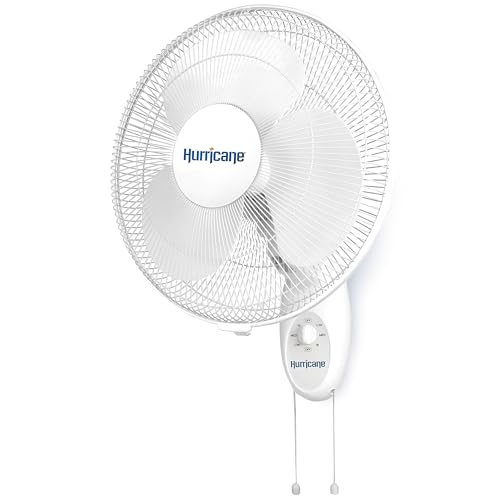
The Supreme costs $0.85 more than the Classic and comes with a 45 dB claim and a turn dial in addition to pull cords. Whether that's worth anything depends heavily on whether your unit's oscillation mechanism holds up.
The 45 dB claim exists, but buyer experience is inconsistent. Some confirm quiet, others report clicking and squealing during oscillation. The oscillation failure mode is not a one-off complaint. It's a pattern. High-speed noise is real. One buyer describes installation on wood and says high speed is quite noisy.
The dial control versus pull cords is a minor convenience win. Don't let the 45 dB spec dominate the decision. It's the claim, not the verdict. Oscillation mechanism is the known weak point.
We earn a commission on purchases via these links. It does not change the price you pay or our ranking.
Remote-Control Models
Step up to a remote and you also get sleep mode, timer, and speed granularity that makes bedroom use actually practical. VAGKRI is the bedroom pick. Fansdrick is for the space that needs a fan and ambient light together.
Best for Bedrooms VAGKRI 16" 5-Speed Wall Mount Fan
Quietest verified by buyers; 5-blade, sleep mode, remote
VAGKRI 16" 5-Speed Wall Mount Fan
Quietest verified by buyers; 5-blade, sleep mode, remote
The 5-blade design is why this is quieter. More blades moving the same volume of air at lower RPM equals less mechanical noise and less wind noise. One buyer notes getting the same airflow on speed 2 that would require speed 4 on a 3-blade fan.
Sleep features: sleep mode, timer, button indicator off, remote across the room. People run this in bedrooms because the noise floor stays low enough to sleep through. One buyer used it to break up heat stratification in a 3-floor open home, kept upstairs rooms livable, reduced A/C bills.
A small periodic ticking during oscillation was noted. Wall anchors in the box are undersized. One buyer ditched the included hardware and used better anchors. At $99.99, 3x the price of the Hurricane pair. Not a budget fan. The genuine quiet pick for bedroom.
We earn a commission on purchases via these links. It does not change the price you pay or our ranking.
Fansdrick 16" DC Motor Wall Fan with Light
DC motor + light; quiet at low speeds; thin buyer data
Fansdrick 16" DC Motor Wall Fan with Light
DC motor + light; quiet at low speeds; thin buyer data
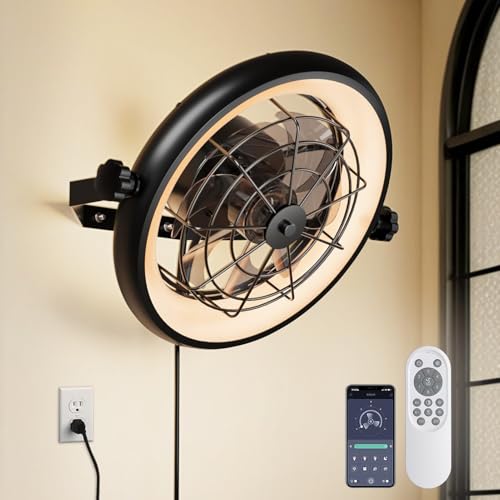
DC motor fans are quieter at low speeds than AC fans. The physics: DC motors can run at truly variable speeds with smoother torque delivery, whereas AC motors step between fixed speeds. At equivalent airflow, DC is quieter. The Fansdrick pairs this with a dimmable LED light in three color temperatures, which is genuinely useful for a salon, bathroom, or covered patio.
The light feature: 3 color temps, 10-100% dimming. Use cases that benefit are salon, bathroom, nighttime patio. App control exists, but thin data means we can't validate reliability. 6 speeds give more granularity than 3-speed competition. Reversible motor for winter circulation is a legitimate feature for cold climates.
Thin buyer data means we cannot make strong editorial claims about real-world performance. At $109.99 it's the most expensive option here and the data support is weakest. If you need the DC + light combo, this is the only option here, but verify with your own research.
We earn a commission on purchases via these links. It does not change the price you pay or our ranking.
Small-Space and RV Picks
Under 10 inches, under $45, validated by buyers in tight quarters. The Shinebella works well in bathrooms and closets. The Koonie has RV hours on it from people who ran it for months straight.
Best Compact Pick Shinebella 8.5" Compact Wall Mount Fan
Compact 8.5" with magnetic remote; oscillation vibrates
Shinebella 8.5" Compact Wall Mount Fan
Compact 8.5" with magnetic remote; oscillation vibrates
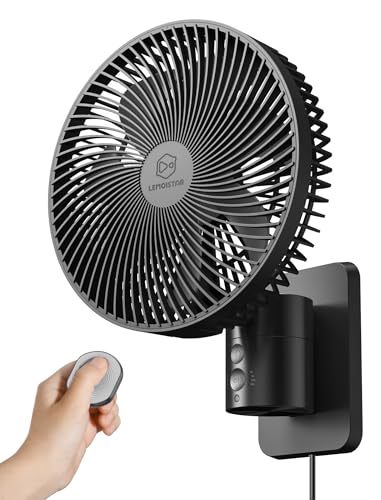
The only genuinely small (8.5") option in the curated set. The magnetic remote is a practical detail that's easy to overlook in the spec sheet. It sticks to the fan grill so you don't spend ten minutes hunting for it in a small bathroom or RV berth.
Size context: 8.5" versus 16" is the difference between a fan for your wall and a fan for a specific corner. Small spaces, bathroom humidity, RV berth. 16-watt draw is genuinely low. That's battery-friendly. The 7-blade design follows the same logic as VAGKRI's 5-blade story, different scale.
Oscillation vibration is the known weak point. Multiple buyers mention the fan vibrates enough during oscillation to be annoying. Not for large rooms. At $44.99, the right call for the right use case. Don't oversell it as a bedroom fan for a large room.
We earn a commission on purchases via these links. It does not change the price you pay or our ranking.
Best for RV Koonie 8" Wired Remote Wall Mount Fan
RV-proven; wired remote stays put; 10W draw
Koonie 8" Wired Remote Wall Mount Fan
RV-proven; wired remote stays put; 10W draw
The wired corded remote (8.2 ft) is the defining feature for RV use. Wireless remotes get lost in a moving vehicle. A remote you can mount in a fixed position next to your bunk and never have to hunt for is the right call for an RV. No line-of-sight required, stays where you put it, never lost.
10W draw is the lowest in this set. On a 12V battery or small inverter, this matters. Memory feature means the fan remembers its last setting after power interruption. One buyer uses this with a smart plug and humidity sensor for automated bathroom ventilation. Two-month Arizona RV trip validation from a buyer who describes it as very quiet and still running like new is the confirmation.
Some buyers find it underpowered for larger spaces. Mounting adhesive is unreliable. Multiple buyers recommend screws for anything that moves or gets vibration. At 8 inches and genuinely RV-proven, this is the right call for a camper, trailer, or small boat cabin.
We earn a commission on purchases via these links. It does not change the price you pay or our ranking.
How to Buy a Quiet Wall Mount Fan
The nerdy part. If you've already found your product above, skip this. If you want to understand why the numbers work the way they do, read on.
dB specs: read them with skepticism
Manufacturer dB numbers are measured at medium speed at distance. High speed on the same fan often reads 10-15 dB louder. The spec gets you in the ballpark; buyer experience tells you the truth. If a fan claims 35 dB and you run it at high speed in a bedroom, you're getting something closer to 50 dB. That's the difference between library-quiet and normal conversation level.
dB reference scale for fans
AC vs DC motor: the real quiet difference
DC motors are quieter at low speeds because they can run at truly variable speeds. AC motors step between fixed settings and tend to hum more. DC costs more (see Fansdrick at $109.99) but the noise difference is real, especially at low speed. If you're running a fan 24/7 at low speed for sleeping, DC is worth it. If you're running it at high speed intermittently in a garage, the DC premium doesn't pay back.
Blade count and RPM
More blades moving the same airflow means lower RPM needed, which means less noise. The VAGKRI 5-blade design is the example. This is not marketing language. It's fan physics. At equivalent airflow, a 5-blade fan can run at lower RPM than a 3-blade fan. That translates directly to less mechanical noise and less wind noise.
Sizing for your space
8-10" fans are for tight spaces. 16" fans are for rooms. Running a 16" fan at medium instead of high is the cheapest noise reduction available. If you buy a 16" fan and always run it at high because medium doesn't move enough air, you bought the wrong size. Match the fan to the space.
Oscillation noise
The fan motor itself may be quiet; the oscillation mechanism often isn't. Clicking, squealing, and vibration during rotation are category-wide complaints. If bedroom quiet is critical, consider locking oscillation off and using the tilt to cover your zone. A steady hum is tolerable. A clicking mechanism wakes you up.
Mounting matters
Drywall plus supplied plastic anchors equals vibration amplification. Into a stud equals quiet. If you can't hit a stud, get better wall anchors than whatever came in the box. A 35 dB fan mounted poorly sounds worse than a 40 dB fan mounted into a stud. Installation is the variable nobody thinks about until it's too late.
Frequently Asked Questions
Are wall mount fans quieter than floor fans?
At equivalent size and speed, not necessarily. The advantage is mechanical: a wall-mounted fan doesn't pick up floor vibrations, so the noise you hear is purer motor and blade noise rather than motor plus cabinet rattling plus floor resonance. A well-mounted wall fan will sound cleaner than a floor fan of the same dB rating, but the baseline noise is similar.
What's a good dB level for a bedroom wall fan?
Under 40 dB for sleeping. 35 dB is achievable on quality low-speed settings. High speed on most fans in this category will exceed 45 dB regardless of the box claim. If you need high speed to stay cool, dB rating matters less than finding a fan with a quiet low-speed setting that still moves enough air.
Do more blades mean quieter fans?
At equivalent airflow, yes. More blades let the fan run at lower RPM for the same CFM output. That means less mechanical noise and less wind noise. It's not always linear, but 5-blade designs outperform 3-blade designs on noise at matching airflow. The VAGKRI 5-blade at 35 dB is the proof of concept.
Why does my wall mount fan vibrate the wall?
Usually a mounting issue (drywall anchors not in stud) or an oscillation mechanism that's slightly unbalanced. First try tightening all bracket screws. If that doesn't fix it, check if the fan body is seated squarely in its bracket. If vibration persists, the oscillation mechanism may be the problem. Some buyers solve this by locking oscillation off permanently.
Is a DC motor wall fan worth the extra cost?
Depends on use. If you run the fan 24/7 at low speed for sleeping, DC is worth it: quieter at low speeds and uses 70-80% less electricity. If you're running it at high speed intermittently in a garage, the DC premium doesn't pay back. The Fansdrick DC at $109.99 is 3x the price of the Hurricane Classic. That delta only makes sense if the DC motor characteristics solve a specific problem you have.
Our last word
If you made us choose
- Bedroom, noise-first
- VAGKRI 16" 5-Speed. 35 dB, 5-blade design, sleep mode, remote. $99.99. The genuine quiet pick.
- Budget, can't justify $100
- Hurricane Classic 16". $35.14. No dB spec, but years of buyer data say it's reliably good enough at medium speed. The backup-unit-is-no-big-deal price.
- RV, camper, or boat
- Koonie 8" Wired Remote. 35 dB, 10W draw, wired remote that stays put. $37.39. RV-proven through a two-month Arizona summer.
- Small space, bathroom, closet
- Shinebella 8.5" Compact. 40 dB, 7-blade, magnetic remote. $44.99. Just know the oscillation vibrates.
We update these picks when the underlying data moves. Prices and availability shift weekly; noise ratings don't.