Shower Pumps · 2026 edition
Quietest Shower Pumps for Camping and RVs (2026)
If you're searching from the UK for a household booster pump, this isn't that page. The first results for "quietest shower pump" split between two completely different product categories: battery-powered camping showers for outdoor use, and 12V diaphragm pumps that power RV and boat plumbing systems. This page covers both.
The noise problem is different for each. Camping: a pump that sounds like a leaf blower at 6am in a quiet campground, with other tents within earshot. RV: a diaphragm pump that kicks on every time someone opens a tap at 2am and sends vibration through the walls. A noisy pump doesn't just irritate you; it wakes everyone around you.
No product on this page has a verified dB spec. No independent lab has measured them. Manufacturers say "ultra-quiet" and "near-silence" but you have no way to confirm it. What we do have: buyer experience across both categories, sorted by use case and labeled honestly by how much data sits behind each conclusion.
This page covers two separate problems (camping showers and RV plumbing pumps) because they need different solutions.
Two Different Problems
Before looking at products, work out which problem you have. The answer changes everything.
Camping: battery pump over a bucket
A portable camping shower is a submersible pump in a battery housing. You lower it into a bucket or bag of water, press a button, and it pushes water through a hose to a showerhead. No plumbing, no installation, 30 seconds to set up.
The noise question for camping is simpler than for RV: does the motor hum audibly enough to disturb the next tent? These pumps run for 60 to 90 seconds per shower and stop. That's a different problem from an RV pump that cycles every time someone touches a faucet. If you're backpacking, weight matters more than motor noise. If you're car camping, battery capacity and filtration quality are the actual differentiators.
RV and boat: 12V diaphragm pump
A 12V diaphragm pump is a permanently installed component in your water system. It self-primes from a freshwater tank and pressurizes the lines automatically whenever you open a tap. In an RV at 2am, that means every bathroom trip triggers a mechanical event the whole rig can hear.
The fix here is two-part: the right pump, installed correctly. Anti-vibration mounts, flexible hose connections, and an accumulator tank (more on those below) reduce transmitted noise more than swapping pump brands. The WASSERMANN is the standout in this category; the SEAFLO 21-series is the cautionary example that shows how installation-dependent the noise really is.
Why no dB numbers?
No independent organization tests portable shower pumps or 12V diaphragm pumps for dB output. Manufacturer claims like "ultra-quiet" and "near-silence" are unverifiable. For context: a library runs around 40 dB, a quiet bedside fan hits 45-50 dB, moderate rainfall sits around 50 dB, and a poorly mounted RV pump can register 65-70 dB through the wall. A well-installed RV pump with anti-vibration mounts and an accumulator can approach 45-55 dB per RV forum consensus. That ceiling depends more on installation than pump model.
What we have instead: buyer reports from campers and RV owners who describe whether the pump woke their partner, disturbed the campsite, or rattled through the walls. Not as clean as a number, but closer to the truth than a press release.
Portable Camping Showers
These battery-powered pumps pull water from a bucket and run on a rechargeable battery. They are not plumbing. The question isn't whether they're perfectly quiet - it's whether they'll wake the people sleeping six feet away in adjacent tents.
Best Budget Camping Shower Novast Portable Camping Shower
Budget camping pick with dual filtration. Buyers haven't flagged it as noisy.
Novast Portable Camping Shower
Budget camping pick with dual filtration. Buyers haven't flagged it as noisy.
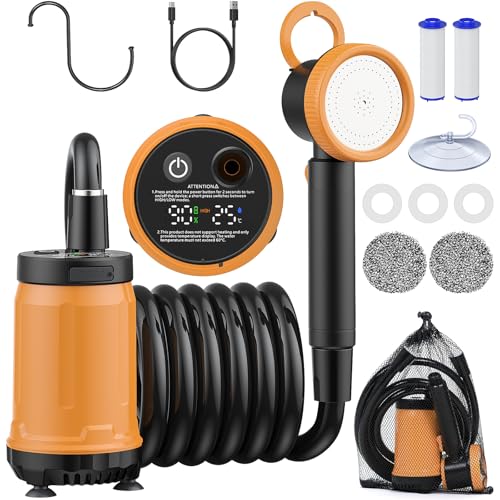
At $27.99, the Novast earns its budget pick status on one spec most camping showers skip: dual filtration. A filter at the pump base catches sediment before it reaches the motor; a second filter at the showerhead handles what gets through. That matters when your water source is a creek or lake. Natural water carries sand, algae, and particulates that a single filter pass often misses.
Buyers switching from gravity bags report stronger flow and simpler setup. One uses the Novast daily for garden irrigation, packs it for camping trips, and notes the motor doesn't register as loud during either use. Battery holds through different applications without needing a midday recharge.
Worth being direct about the data: this is a new product with a thin review sample, not enough for strong noise conclusions. We're not calling it whisper-quiet. What buyers have said is that noise hasn't come up as a problem, and at this price, that's enough to make it the budget pick. Buy it knowing the sample is small.
We earn a commission on purchases via these links. It does not change the price you pay or our ranking.
B013 7800mAh Camping Shower
Long battery life and LED temperature display. Quiet per camper reports.
B013 7800mAh Camping Shower
Long battery life and LED temperature display. Quiet per camper reports.
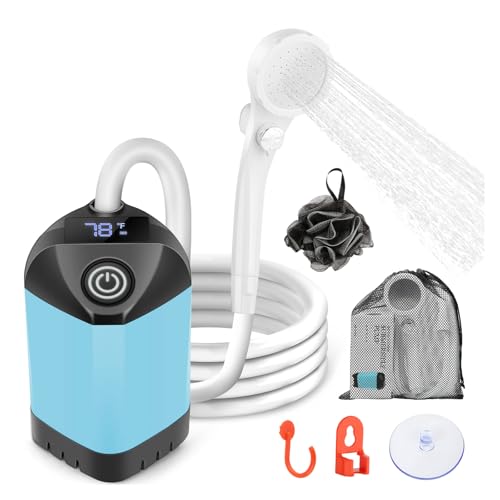
7800mAh is serious capacity for a camping shower. Buyers report the battery lasted a full camping trip without a recharge, covering multiple people across multiple showers before needing a USB-C top-up. That's the main story here.
The LED temperature display is a genuine safety feature, not a gimmick. Solar-heated water in a dark bag on a hot day can reach scalding temperatures without warning. A readout before you open the valve prevents burns. It also tells you when solar heating has done its job so you're not showering in cold water when the bag has been sitting in sun all afternoon.
Three spray modes (gentle, full, pulsing), four suction cups for bucket stability, and IPX8 waterproofing round out the practical specs. On noise: one camper described the pump as quiet enough to avoid disturbing tentmates. We're not overstating it, but it's there, and the general buyer tone doesn't contradict it.
We earn a commission on purchases via these links. It does not change the price you pay or our ranking.
Tipkook 10000mAh Camping Shower
Biggest battery here. Zero noise-specific buyer feedback; we can't speak to it.
Tipkook 10000mAh Camping Shower
Biggest battery here. Zero noise-specific buyer feedback; we can't speak to it.
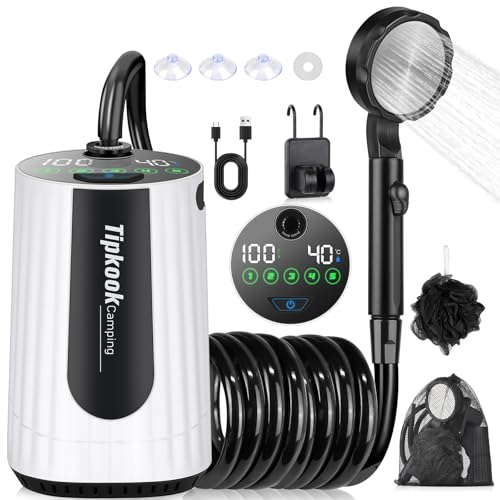
If battery capacity is the deciding factor, nothing else on this page touches 10,000mAh. For a group camp, a multi-day trip off-grid, or heavy daily use, that advantage is real. Five adjustable speed settings give more granularity than the competing options here. Buyers describe good pressure and easy setup.
The honest problem: across all buyer feedback, not one person mentions noise. We cannot say whether this pump is quiet, acceptable, or disruptive in practice. The manufacturer claims "near-silence" and we have no buyer data to support or refute that. We're not repeating it as fact.
Reliability is genuinely mixed. Some units hold up through extended use; others stopped working entirely. That inconsistency matters on a trip where a broken shower pump can't be replaced at a camp store. If maximum battery capacity is your priority and noise is secondary, this is the pick. Just go in knowing what we don't know about the motor.
We earn a commission on purchases via these links. It does not change the price you pay or our ranking.
12V RV Water Pumps
Permanent-mount diaphragm pumps for RV and boat plumbing. These run automatically every time you open a tap. In an RV at 2am that means every bathroom trip is a mechanical event. The WASSERMANN is the standout; the SEAFLO is the cautionary tale.
Quietest RV Upgrade WASSERMANN 12V RV Water Pump
Clear noise improvement over stock RV pumps. Doesn't idle-cycle at standby.
WASSERMANN 12V RV Water Pump
Clear noise improvement over stock RV pumps. Doesn't idle-cycle at standby.
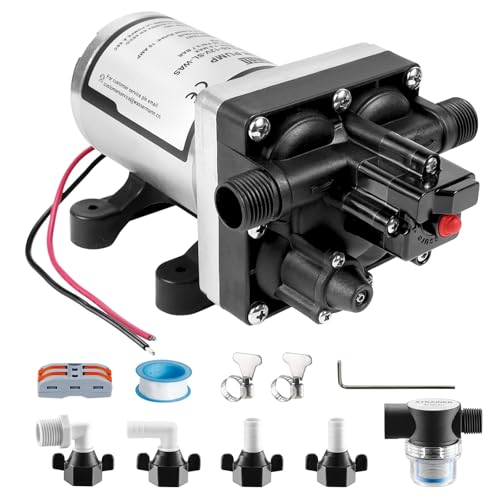
Buyers aren't buying the WASSERMANN cold against a spec sheet. They're replacing a stock pump that was making their RV miserable, and the before-and-after is what drives the signal.
One buyer worked through two expensive pumps that burned out before finding this one. The WASSERMANN solved both the noise and the constant-cycling problem in a single swap. Another buyer's stock pump was loud, had weak pressure, and cycled continuously at standby; the WASSERMANN addressed all three issues. A third, using the pump in demanding non-RV equipment (maple syrup production), reported smooth, solid operation under sustained load. An unusual use case that suggests the build quality holds up.
The automatic pressure shutoff is the key noise feature. When a tap closes, the pump pressurizes the line and stops completely. No idle cycling, no background hum waiting for the next demand. In an RV that means the system is genuinely silent when nobody is using water.
Small sample, but the signal is clear and consistent. Three-year warranty, all accessories included. We acknowledge the thin data and still call it the standout because the buyer context is unusually specific: people who switched from loud stock pumps and describe a genuine, named improvement.
We earn a commission on purchases via these links. It does not change the price you pay or our ranking.
SEAFLO 21-Series Diaphragm Pump
Noise feedback is genuinely split. Installation-dependent. Single-fixture coverage only.
SEAFLO 21-Series Diaphragm Pump
Noise feedback is genuinely split. Installation-dependent. Single-fixture coverage only.
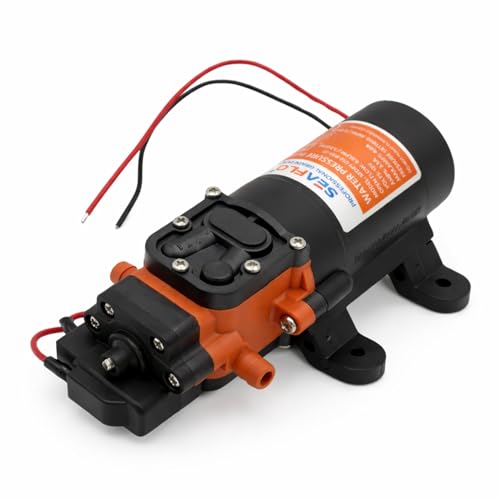
The SEAFLO 21-series has more buyer history than any other pump on this page, which is why the noise picture is so legible: it's divided. Not a few outliers on each side, but a genuine split between buyers who find the noise acceptable and buyers who describe it as very loud. That's not a data artifact. That's reality.
The split traces directly to installation. One buyer mounted it in a 4x4 rock crawler and found the noise tolerable for that application. Another installed it in a bedroom-adjacent RV compartment and described it as sounding like a motorboat. Same pump, different mounting surface, completely different result. Screw a diaphragm pump to a hollow fiberglass cabinet wall and the whole rig hears it. Mount it on rubber isolator pads over a solid surface and the same pump becomes manageable.
1.2 GPM output means single-fixture coverage only. Buyers who expected to run a full RV plumbing system were disappointed when pressure dropped under multi-fixture demand. Off-grid single-sink setups: acceptable. RV bedroom-adjacent at 2am: the wrong pump for the job. It's here because it's widely purchased and the cautionary case is worth making explicitly, not because we recommend it for quiet RV applications.
We earn a commission on purchases via these links. It does not change the price you pay or our ranking.
All 5 Picks at a Glance
No verified dB specs exist for any product here. The noise column reflects editorial judgment based on buyer experience, not a number measured in a lab. "No verified spec" is the honest answer for this category, not an omission.
| Product | dB | Use Case | Price | Badge | Verdict |
|---|---|---|---|---|---|
| Novast Portable Shower for Camping | No verified spec | Portable | $28 | Best Budget Camping Shower | Thin data but buyers haven't flagged it as noisy. Dual filters is a plus. |
| B013 Portable Shower Pump for Camping – 7800mAh Long | No verified spec | Portable | $34 | Campers report quiet operation. Long battery and LED display stand out. | |
| Portable Shower for Camping Essentials: IPX8 Waterproof Camping Shower | No verified spec | Portable | $46 | No noise data; take manufacturer claims with skepticism. Big battery. | |
| WASSERMANN RV Water Pump 12V DC 4008 | No verified spec | RV Install | $64 | Quietest RV Upgrade | Buyers replacing loud stock pumps describe a clear improvement. |
| SEAFLO 21 | No verified spec | RV Install | $33 | Mixed noise feedback. Acceptable for single-fixture off-grid; wrong for RV. |
Making Any Pump Quieter
For RV and boat pumps, installation quality affects perceived noise more than pump brand. These steps deliver more return than a brand upgrade.
Anti-vibration mounts (RV pumps)
Rubber isolator pads between the pump body and the mounting surface cost $5 to $15 and are the single highest-return noise upgrade available. A diaphragm pump generates vibration with every stroke; rigid mounting to a hollow panel transmits that vibration through the entire structure. Rubber breaks the transmission path. Install these before concluding your pump is simply loud.
Accumulator tanks
An accumulator tank adds a small pressurized reservoir to the system. Brief demands like filling a glass or rinsing hands draw from the reservoir without triggering the pump at all. Longer flows eventually deplete the reservoir and the pump runs, but at a steadier demand rather than rapid on-off cycles. The result is fewer pump starts per hour, less wear on the motor, and a significant reduction in noise for any system that cycles frequently.
An accumulator isn't required, but it's strongly recommended for any RV where the pump runs constantly at standby. If the pump cycles every 60 to 90 seconds when no water is in use, check for a plumbing leak first. A small drip somewhere in the system creates back-pressure that triggers the pump repeatedly, and no accumulator fixes a leak.
Flexible hose connections
Use flexible braided hose at the pump inlet and outlet rather than rigid copper or hard plastic. Rigid connections at the pump body transmit vibration directly into the plumbing run. A short section of flexible hose isolates the pump mechanically even if the mounting isn't optimal.
Mounting surface
Solid wood or foam-backed panels absorb vibration; hollow cabinet walls amplify it. If the pump is audible through a wall, the wall is acting as a resonator. Remounting on a denser surface, or adding mass to the existing surface (dense foam tape, sheet rubber), changes the acoustic result before you spend anything on a new pump.
Camping pump factors
For portable camping showers, the practical buying factors are: battery capacity (how many showers per charge before you need to plug in), filtration quality (critical for creek or lake water with sand and biologics), hose length, spray modes, temperature display (a safety feature for solar-heated water, not a gimmick), and weight if you're backpacking rather than car camping. Noise is one variable among several, and for 60-second showers, a quieter motor matters most in dense campgrounds where tents are close together.
Suction cups on the bucket and soft ground under the bucket reduce rattling from the pump motor against a hard container surface. Simple, free, and worth doing before attributing campsite noise to the motor itself.
Frequently Asked Questions
Why is my RV water pump so loud?
Two causes, usually both present. The pump's diaphragm mechanism generates inherent vibration with each stroke. That's fundamental to how positive-displacement pumps work. But more often than not, the louder culprit is vibration transmission through the mounting surface: a pump screwed directly to a hollow fiberglass panel turns the panel into a speaker. Anti-vibration isolator pads between the pump and the mount break this transmission path and often make more difference than swapping pump models. If the pump also cycles constantly when no water is in use, check for a plumbing leak. A small drip somewhere in the system creates continuous back-pressure that runs the pump on repeat, and no noise treatment addresses the underlying cause.
Do I need an accumulator tank with my RV water pump?
Not required, but it meaningfully reduces noise for any system that cycles frequently. An accumulator holds pressurized water in a small reservoir. Brief draws like filling a glass or a quick rinse come from the reservoir without triggering the pump at all. Longer draws eventually deplete it and the pump catches up, but at steadier intervals rather than rapid cycling. Fewer pump starts per hour means less noise and less wear on the motor over time. If your pump runs constantly at standby with no taps open, diagnose for leaks first before adding an accumulator.
Can I use a camping shower pump for my RV?
No. A submersible battery pump is designed to push water from an open container downward through a hose. It cannot self-prime against gravity from a tank below pump level, cannot maintain closed-system line pressure, and cannot handle continuous demand across multiple fixtures. A 12V diaphragm pump and a portable camping shower are fundamentally different products built for different applications. Putting a camping pump into an RV plumbing system won't work.
How do I make my shower pump quieter?
For RV and boat pumps: start with anti-vibration isolator pads between the pump and its mount ($5 to $15), add an accumulator tank if the pump cycles frequently at standby, and use flexible hose at the pump inlet and outlet rather than rigid pipe connections. Check for plumbing leaks if the pump runs when no taps are open. For camping pumps: use suction cups inside the bucket and set the bucket on soft ground rather than a hard surface to reduce transmitted vibration. In both cases, installation quality shapes perceived noise more than pump model. The same unit mounted correctly sounds significantly different from the same unit mounted badly.