Oscillating Fans · 2026 edition
Quiet oscillating fans that actually deliver (2026)
The honest version of this category is smaller than most roundups admit. Of the ten fans we pulled from the data, four were swamp coolers wearing oscillating-fan costumes, and three had buyer pools too thin to trust. What is left is three fans that actually belong here and three use cases that are genuinely different from each other.
A DC motor bedroom fan where 20 dB buyer confirmation is real. A brushless wall-mount built for workshops where 45 dB at 4000 CFM makes sense. And a budget stand fan with no spec and thousands of reviews that tell you what $30 actually gets. Different people need fans for different situations, and the noise bar shifts dramatically depending on where the fan lives.
All 3 Picks: Sorted by Use Case
Bedroom first, workshop second, budget third. Every product we recommend is here, with its dBSkeptic rating and a one-sentence verdict. This table is the fastest way to find your match.
| Product | dB | Type | Price | Badge | Verdict |
|---|---|---|---|---|---|
| DREO Fan for Bedroom | 20 dB | Standing/Pedestal | $80 | Quietest Overall | DC motor, buyer-confirmed quiet at low speeds, 8 speeds |
| FUGOO 20" Brushless DC Industrial Outdoor Oscillating Wall Mount Fan | 45 dB | Wall Mount | $220 | Best for Workshops and Garages | Brushless DC wall-mount, quiet for 4000 CFM industrial output |
| Lasko 2520 Oscillating Stand Fan | No spec | Standing | $30 | Best Budget Pick | No dB spec, mixed noise signal - some rattle, buyer lottery |
For the bedroom and home
When quiet is the job, a DC motor fan under 30 dB is worth the price premium. Here is what the data actually says at the budget-to-mid range.
Quietest Overall DREO 2026 Upgraded Pedestal Fan
DC motor, buyer-confirmed quiet at low speeds, 8 speeds
DREO 2026 Upgraded Pedestal Fan
DC motor, buyer-confirmed quiet at low speeds, 8 speeds
Buyers describe using the remote to switch it on mid-night without waking anyone, noting zero motor hum at the lowest speeds.
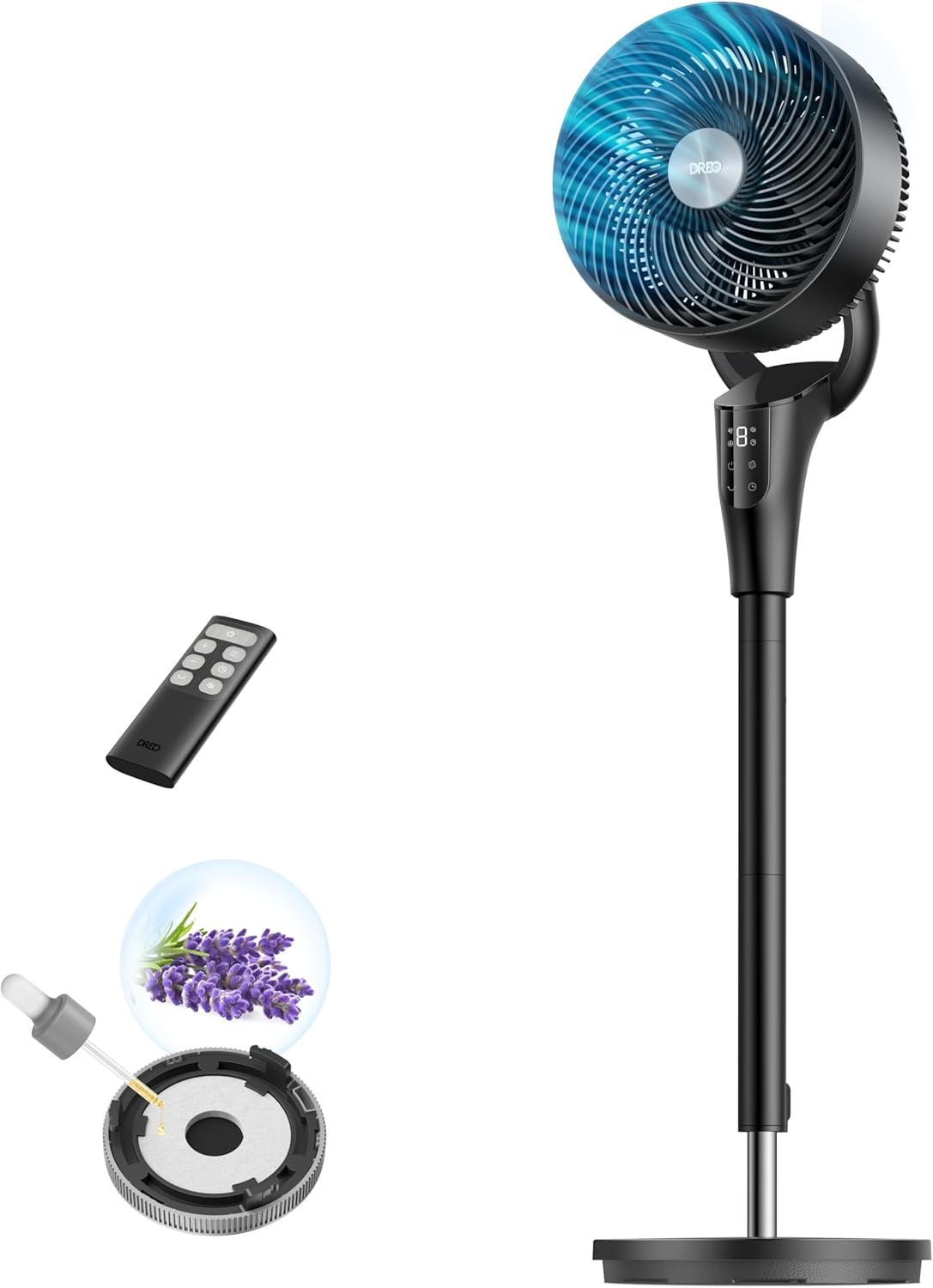
20 dB at minimum speed. That claim is manufacturer-spec, not an independent measurement. Usually that would be a yellow flag. But the DREO has thousands of buyers commenting specifically on how quiet it is, and those patterns are consistent across a wide range of speeds. That level of buyer confirmation makes the claim worth taking seriously, at least at low settings.
The DC brushless motor is the engineering difference. Buyers describe using the remote to switch it on mid-night without waking anyone, noting zero motor hum at the lowest speeds. Some paraphrase it as near-silent operation at low settings. That consistency across independent buyers is the signal that matters.
8 speeds plus auto mode. With 3-speed AC fans you are stuck between too cold and too loud. Eight speeds lets you find the sweet spot. 90 degree oscillation, 105 degree manual vertical tilt, adjustable height 38 to 42 inches. The height range lets you aim airflow above or below furniture.
Aroma pad is a differentiator that divides buyers. It exists. Some use it, some ignore it. Not a selling point, just an option. The mixed signal on size: the fan is smaller than many buyers expect. Not a noise issue, but worth one line so you are not surprised. Detachable design for cleaning is a practical long-term quality point.
We earn a commission on purchases via these links. It does not change the price you pay or our ranking.
Workshops, garages, and outdoor spaces
A garage workshop runs louder ambient noise than a bedroom. A 45 dB wall-mount fan that moves 4000 CFM is genuinely quiet for that environment - context matters.
Best for Workshops and Garages FUGOO 20 Inch Brushless DC Wall Mount Fan
IP53 waterproof, 4000 CFM, brushless DC - quiet for what it moves
FUGOO 20 Inch Brushless DC Wall Mount Fan
IP53 waterproof, 4000 CFM, brushless DC - quiet for what it moves
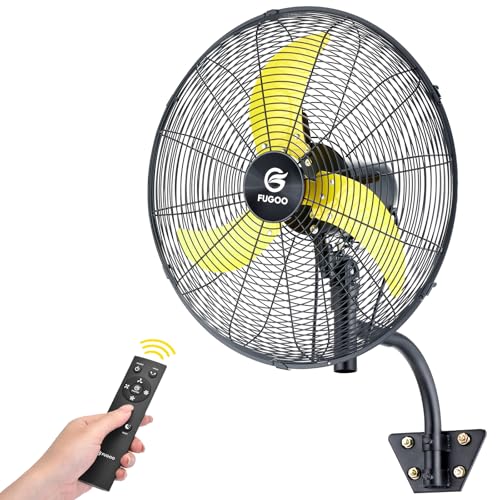
Completely different use case from the DREO. This fan exists for garages and workshops where you need airflow you can stand across the room from and still feel. 4000 CFM, wall-mount, IP53 weatherproofing. The 45 dB figure sounds loud next to the DREO, but in a garage running power tools, 45 dB from the fan is not the problem.
Brushless DC motor. Not just a premium spec, it genuinely removes the 60Hz AC hum. At 45 dB, the character of the noise is less fatiguing than an equivalent-volume AC fan. The few reviews that exist are positive on noise, which is consistent with brushless DC physics.
IP53 waterproofing means splash-proof, not waterproof. Fine for a patio or open garage door. Not rated for direct rain exposure. 4000 CFM. Contextualize it: the DREO moves around 1000 CFM. This fan moves four times the air. That is why 45 dB is still a reasonable noise-to-output ratio.
Wall-mount frees floor space. In a workshop where floor space is equipment, that matters. 90 degree oscillation, 15 degree tilt up and down. Remote to 65 feet. Moderate buyer data, do not overclaim consensus. The positive reviews on noise are consistent but not extensive.
We earn a commission on purchases via these links. It does not change the price you pay or our ranking.
Budget picks and what to expect
The $30 oscillating fan exists. Whether it is quiet depends partly on which unit you get. Here is an honest read on what to expect.
Best Budget Pick Lasko 2520 16-Inch Oscillating Stand Fan
No dB spec, mixed noise signal - some rattle, buyer lottery
Lasko 2520 16-Inch Oscillating Stand Fan
No dB spec, mixed noise signal - some rattle, buyer lottery
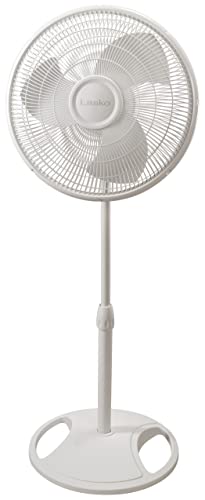
No manufacturer dB spec. That is honest. The noise reality comes from buyer reports, not a marketing sheet. The Lasko is the cheapest fan on this list and the one with the most reviews. It is also the noisiest, which is partly by design (AC motor, three fixed speeds) and partly a buyer lottery. Some units rattle, some do not, and there is not much in the box to predict which one you will get.
Noise character when working: buyers who got good units describe consistent pleasant sound, used as white noise for sleep. The 60Hz consistency is what makes it tolerable even at higher volume. Buyers describe the noise as steady and unobtrusive at all three speeds, with no high-pitched squealing or variable thrum.
Noise character when not working well: other buyers report loud rattling. The pattern in reviews suggests this is unit variance, not a universal design flaw. Shipping damage, blade imbalance, and loose housing are the typical causes. The durability picture is also mixed. Some units run for years, some fail within months.
Stability: a recurring complaint is the fan does not stay upright or wobbles. Three speeds only (AC motor). At 3 speeds there is no fine-tuning, you get what you get. It moves a lot of air for $30. That part is real. But do not describe it as a quiet fan without qualification.
We earn a commission on purchases via these links. It does not change the price you pay or our ranking.
How to Buy a Quiet Oscillating Fan
The nerdy part. If you have already found your product above, skip this. If you want to understand why the numbers work the way they do, read on.
What quiet actually means for a fan (dB thresholds)
For sleep: aim under 40 dB at the speed you actually use, not the theoretical minimum. Light sleepers: aim under 30 dB. Heavy sleepers or white-noise users: 40 to 45 dB is fine. For office or work: 45 to 50 dB is acceptable if airflow quality is high enough that you can run it slower.
For garage or workshop: ambient environment often runs 60 to 70 dB when work is happening. 45 to 50 dB from the fan is not the noise problem. Context: a quiet library is about 40 dB. A normal conversation is around 55 dB. Put the fan in those terms.
DC motor vs AC motor, the real difference
DC motors eliminate the 60Hz electromagnetic hum that AC motors produce. That hum is consistent and fatiguing even at low volumes. At the same dB reading, DC fans often feel quieter because the character of the noise is smoother. Real-world difference: roughly 3 to 8 dB on low speeds, narrowing on high speeds.
The price premium for DC is real, typically $30 to $60 more than equivalent AC fans. For bedroom use, it is usually worth it. The DREO at $80 is DC, the Lasko at $30 is AC. That $50 gap is the motor difference.
Oscillation adds noise (most pages skip this)
The oscillation gear motor runs continuously when oscillation is active. In budget fans, worn or cheap plastic gears add clicking or grinding. In quality fans with metal gears, the addition is 2 to 5 dB, audible but not a deal-breaker. Turning off oscillation will typically lower the noise floor slightly.
Why your fan might be louder than the spec says
Manufacturers measure in anechoic chambers. Real rooms have hard surfaces that reflect sound. Resonance: if the fan vibration frequency matches something in your room (a wall, furniture, a window), the perceived noise can jump 5 to 10 dB.
Blade imbalance from shipping damage adds wobble and noise. Dust buildup on blades creates turbulence over time. Loose plastic housing after months of use, screws loosen, panels vibrate. The Lasko buyer lottery is a real example of this variance in practice.
Airflow vs noise tradeoff (the conversation most guides avoid)
Quieter fans move less air at equivalent noise levels. This is physics, not a quality flaw. A 20 dB fan at its actual quiet speed might be moving 300 CFM. A 45 dB industrial fan moves 4000 CFM. Both can be the right answer depending on the room.
The question is: what is the quietest fan that moves enough air to do the job? That threshold is different for a bedroom versus a workshop. The DREO is right for bedrooms. The FUGOO is right for workshops. They are solving different problems.
Tower fan vs pedestal fan, which is quieter?
Neither has a clear edge. Bladeless tower fans still have impellers, they are just hidden. Noise depends on motor quality and blade design, not form factor. Match the form factor to how you want to direct airflow. Pedestals give you height adjustment. Towers save floor footprint. Choose based on space and airflow needs, not noise assumptions.
Frequently Asked Questions
What dB level is quiet for an oscillating fan?
For sleep, aim under 40 dB at the speed you actually use. Under 30 dB is near-silent territory. Most bedroom-use fans land 35 to 45 dB on low. The DREO at 20 dB is the standout, but even 40 dB is genuinely quiet for a fan.
Are DC motor fans actually quieter than AC fans?
Yes, measurably. 3 to 8 dB on low speeds in real-world conditions. More importantly, the noise character is smoother. DC fans eliminate AC motor hum, which is fatiguing even at low volumes. The DREO DC fan at 20 dB versus the Lasko AC fan with no spec is the lived example of this difference.
Does oscillation make fans louder?
Yes, typically 3 to 7 dB from the gear motor, more in budget fans with plastic gears that wear over time. Turning off oscillation will reduce the noise floor. The Lasko rattling complaints are partly oscillation-gear related.
Tower fan vs pedestal fan, which is quieter?
Neither has a clear edge. Bladeless tower fans still have impellers, they are just hidden. Noise depends on motor quality and blade design, not form factor. Match the form factor to how you want to direct airflow, not noise assumptions.
Why is my fan louder than the box says?
Manufacturers measure in anechoic labs, not your bedroom. Room resonance, blade dust, loose housing, and worn bearings all add noise. Measure from 6 feet in your actual room for a realistic baseline. The Lasko buyer lottery is partly this variance showing up in practice.