Nebulizers · 2026 edition
Quietest Nebulizers: Mesh Tech and Honest Data (2026)
The search for the quietest nebulizer hits a wall fast: almost every listing claims "less than 25 dB," and almost none of them have independent measurements to back it up. We looked at six options across three use cases. The honest version of what we found is this: the technology gap between mesh and jet compressor is real, the specific numbers on product pages are not.
One product in our set has actual buyer confirmation of quiet operation. One. The rest are manufacturer specs with no independent standard behind them. We're telling you that up front, because every competitor treats those claims as fact. We don't think that serves you.
Below: three myths worth debunking first, then the products, then a buying guide covering the one thing more important than noise (medication compatibility).
Three myths worth clearing up first
The nebulizer category is unusually noisy with bad information. Before you read any product writeup, these three assumptions are worth examining.
"Mesh nebulizers are always quieter than jet nebulizers."
Reality
True in general. Mesh technology (20-35 dB range) is genuinely quieter than jet compressors (45-65 dB range). The physics are real: no pump, no piston, just a vibrating membrane. But the sub-20 dB and sub-25 dB claims on specific product listings are manufacturer-sourced numbers with no independent measurement standard behind them. The technology advantage is real. The exact number on the listing is not.
Why it matters: Trust that mesh is the right technology for quiet. Don't trust the specific dB figure on the product page.
"A quiet nebulizer delivers medication less effectively."
Reality
False for mesh. Mesh nebulizers produce particle sizes of 2-4 µm MMAD, which falls within the 1-5 µm clinical target for lower-airway deposition. They're also faster: 5-8 minutes versus 10-15 minutes for jet compressors. Quiet is not a trade-off for efficacy here.
The exception is suspension medications. Budesonide (Pulmicort), tobramycin, and similar suspensions clog mesh membranes and result in under-dosing. If you use a suspension medication, this is the most important thing on this page. Check with your pharmacist or prescriber before buying a mesh nebulizer.
Why it matters: Medication compatibility is a hard gate. Get it wrong and the device is useless regardless of how quiet it is.
"All portable nebulizers are quiet."
Reality
No. Battery-powered jet compressors exist. Some are louder than tabletop models because the motor is smaller and there's less insulation around it. "Portable" describes the power source, not the mechanism. Only mesh portables reliably clear the noise bar.
Why it matters: The budget options labeled "portable" at $18-$30 on Amazon are frequently compressors. Check the mechanism, not the form factor.
All 6 Picks at a Glance
The dB column shows claims or buyer-reported values, not independently verified measurements. "Silent (buyer)" is the only entry with owner confirmation.
| Product | dB | Mechanism | Price | Badge | Verdict |
|---|---|---|---|---|---|
| Portable 8cc Mesh Nebulizer with Case - Rechargeable Handheld Nebulizer Machine | <25 dB claimed | Mesh | $60 | Best for Travel | Mesh tech, 6hr battery, travel case. Zero reviews yet. |
| Portable Mesh Nebulizer for Adults & Kids | unverified | Mesh | $60 | 5µm particle size is meaningful. No noise spec given. | |
| Pet Nebulizer with USB Port - Portable and Handheld for Dogs/Cats | <50 dB claimed | Portable | $18 | Best Budget Pick | Most credible spec in the set. Budget option at $18. |
| WIKSRY Dogs Nebulizer for Breathing Problems | silent (buyer) | Pet | $37 | Best for Dogs | Only buyer-confirmed quiet device in our set. |
| WIKSRY Cat Nebulizer for Breathing Problems | unverified | Pet | $40 | Moderate pool, no noise complaints surfacing. Mild positive signal. | |
| Portable Nebulizer - Ultrasonic Rechargeable Nebulizer Machine for Dogs/Cats | <=20 dB claimed | Pet | $50 | 3-mode ultrasonic. Bold spec, zero buyer validation. |
Human Mesh Nebulizers
Mesh nebulizers are the only technology where “won't wake a sleeping household” is plausible. No pump, no piston, just a vibrating membrane. Two options here, both from unknown brands with zero buyer reviews. Thin data territory.
Best for Travel Portable 8cc Mesh Nebulizer A26
Mesh tech, 6hr battery, travel case. Zero reviews yet to confirm the specs.
Portable 8cc Mesh Nebulizer A26
Mesh tech, 6hr battery, travel case. Zero reviews yet to confirm the specs.
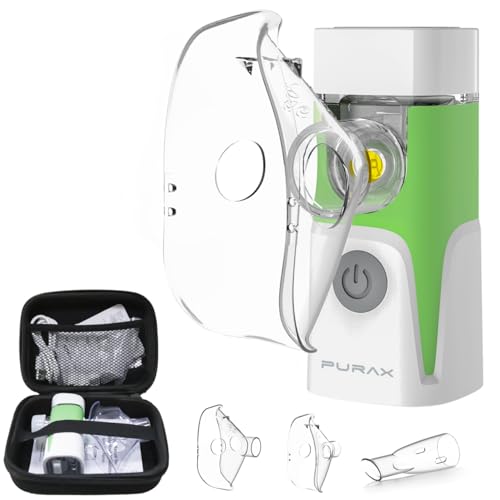
Mesh is the right technology if quiet matters. The mechanism is simple: a membrane with microscopic apertures vibrates at ultrasonic frequency to push liquid through as aerosol. No pump, no motor driving a piston. The result is inherently near-silent, which is why the 20-35 dB range for mesh nebulizers is real physics, not just marketing.
This device claims less than 25 dB via what the listing calls "advanced noise reduction technology." That's manufacturer language for "mesh aperture design," and the underlying claim is plausible. What it isn't is independently verified. There are zero buyer reviews on this listing as of writing. You're taking the company's word for it.
The practical specs are meaningful. Six hours of runtime on a 3-hour charge makes it useful for travel, multi-use days, or anyone who can't guarantee access to an outlet. The included travel case matters more than it sounds: mesh membranes are fragile and need protection from pocket lint and impact. Dual speed modes let you dial for particle size. The 8cc medication capacity is on the smaller side but workable for standard treatment volumes.
The listing also mentions "closed-loop AI-mesh technology." Ignore that phrase entirely. The real advantage is the aperture geometry of the mesh, which determines particle size consistency. There is no AI in a vibrating metal disc.
We earn a commission on purchases via these links. It does not change the price you pay or our ranking.
Vnvfd Portable Mesh Nebulizer
5µm particle size claim is the meaningful spec. No dB figure given.
Vnvfd Portable Mesh Nebulizer
5µm particle size claim is the meaningful spec. No dB figure given.
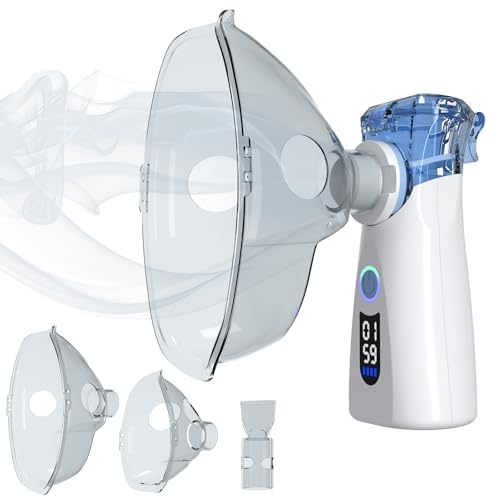
No dB spec on this listing. The product name includes the word "quiet," which is not a specification. What the listing does give is a 5 µm particle size claim, and that number is actually worth reading.
Five microns sits at the upper end of the 1-5 µm therapeutic window for lower-airway deposition. Fine for asthma management. Less useful for deep bronchial conditions where you want to target below 3 µm. For upper-airway conditions (sinuses, upper respiratory infections), 5 µm is appropriate and efficient. Know what you're treating before deciding whether this is the right particle size for your use case.
- Adult and infant masks included - covers a household without separate purchases
- 20-minute auto shut-off - useful safety feature; also the maximum continuous session before needing a restart
- 0.5 mL minimum fill volume - reduces medication waste compared to jet cups that require 4-5 mL minimums
- Zero buyer reviews - no noise data, no reliability signal, nothing
The honest summary: the efficacy specs are reasonable for a mesh device. The noise claim is absent. If quiet is your primary concern and you can't tolerate any ambiguity, the A26 at least states a number (unverified as it is).
We earn a commission on purchases via these links. It does not change the price you pay or our ranking.
Budget and Portable
For backup nebulizers, travel units, or mild upper-respiratory treatment where you don't need the full mesh technology stack. One option here, and it's unusually honest about what it is.
Best Budget Pick Generic USB Portable Nebulizer
Claims <50 dB rather than <25 dB. The most plausible spec in the set.
Generic USB Portable Nebulizer
Claims <50 dB rather than <25 dB. The most plausible spec in the set.
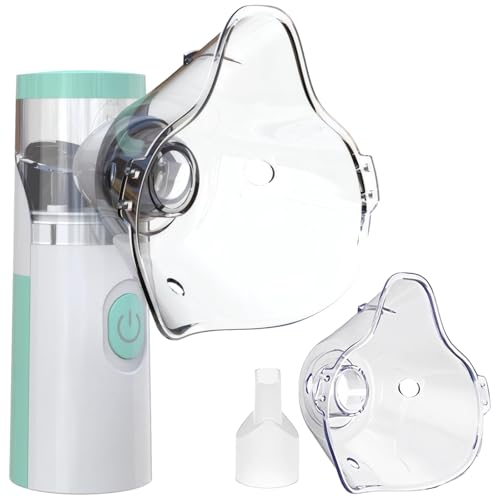
The sub-50 dB claim here is paradoxically more credible than the sub-25 dB claims elsewhere. Under 50 dB is a plausible real-world number for a small portable compressor. Not an extraordinary claim. Not a mesh nebulizer promising whisper-quiet with no mechanism behind it. 50 dB is roughly moderate rainfall, or a quiet office environment. Borderline for nighttime use next to someone sleeping. Fine for daytime treatment.
The price is $18.29. USB-C rechargeable, dual-use design with both human and pet masks, mist output above 0.2 mL/min (workable but on the low end). Owner data is essentially absent - the listing has almost no buyer history to draw from. Treat it as an unknown quantity. That's not a dealbreaker at this price point; it's just the honest context.
This is a reasonable backup nebulizer, a sensible choice if you need a travel unit that's genuinely cheap, or a workable option for households that need both human and pet coverage without spending on two separate devices. It is not comparable to a mesh nebulizer acoustically. Plan around approximately 50 dB, not 25 dB.
We earn a commission on purchases via these links. It does not change the price you pay or our ranking.
Pet Nebulizers
Animals cannot be reasoned with about treatment duration. A cat that bolts at 55 dB receives no medication. The noise threshold for acceptable pet compliance is approximately 40 dB for cats, 45 dB for dogs, which rules out nearly every compressor nebulizer.
Best for Dogs WIKSRY Dog Nebulizer
One buyer confirmed it ran silently during treatment. The only verified quiet device in this set.
WIKSRY Dog Nebulizer
One buyer confirmed it ran silently during treatment. The only verified quiet device in this set.
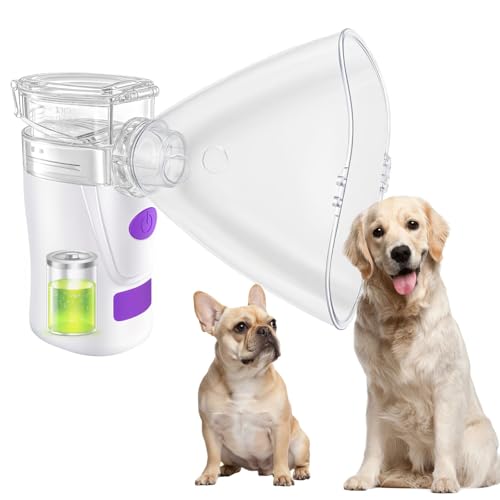
Every other product in this set has manufacturer-only noise claims. This one has a buyer account. One owner described the device running silently during treatment, found it easy to hold and position during sessions even with a wiggly dog, and noted that the compact form factor made it manageable throughout. That's a thin signal. One person. But it's the only buyer-confirmed noise performance in the entire set, and that distinction matters.
The listing claims "low noise for comfort," which is vague enough to be meaningless on its own. The single buyer experience gives it substance. Take it for what it is: one data point in a thin pool, not a pattern.
- Size: 4 inches tall, 1.6 inches wide - manageable for medium and larger breeds; check mask fit carefully for very small dogs
- Medication chamber lock: some buyers find it hard to reopen after snapping shut - factor this into your post-treatment cleaning workflow
- Thin buyer pool - better than zero, not enough to establish strong reliability signal
For dog owners with a veterinary nebulizer prescription and noise as the primary concern, this is the strongest option in the set based on available data. The bar is low, because the data across this category is thin. That's the honest read.
We earn a commission on purchases via these links. It does not change the price you pay or our ranking.
WIKSRY Cat Nebulizer
Moderate pool with no noise complaints surfacing. Mild positive signal for a cat device.
WIKSRY Cat Nebulizer
Moderate pool with no noise complaints surfacing. Mild positive signal for a cat device.
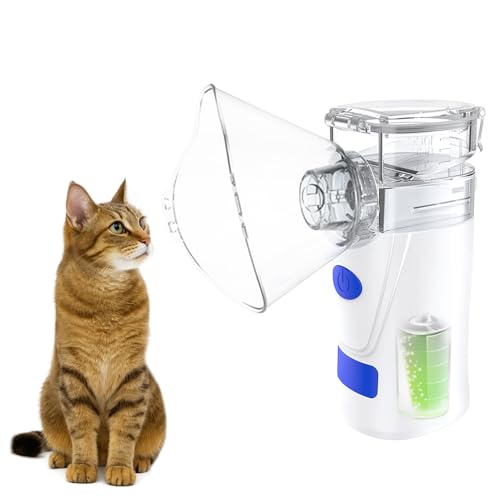
Noise does not appear as a recurring complaint anywhere in this listing's buyer pool. That's a moderate pool for this category. In a device used on stressed animals that bolt at any sudden sound, the absence of noise complaints is a mild positive signal. It is not proof of quiet operation. It is consistent with quiet operation.
The noise threshold for cats is stricter than for dogs, at around 40 dB. If the dog version of this product runs silently (one buyer confirms it does), the cat version from the same manufacturer using the same construction likely performs similarly. That's an inference, not a measurement. We're flagging the logic explicitly rather than presenting it as fact.
What the reviews do confirm: the cat-specific mask geometry fits the feline muzzle well enough for adequate seal, and the device disassembles easily for cleaning. Both matter for repeated daily use. A mask that doesn't seal properly means your cat receives less medication than the treatment plan specifies. Easy disassembly means you'll actually clean it, which extends membrane life.
We earn a commission on purchases via these links. It does not change the price you pay or our ranking.
Naweti Pet Nebulizer
Claims 20 dB or less with zero buyer validation. The multi-mode design is genuinely useful.
Naweti Pet Nebulizer
Claims 20 dB or less with zero buyer validation. The multi-mode design is genuinely useful.
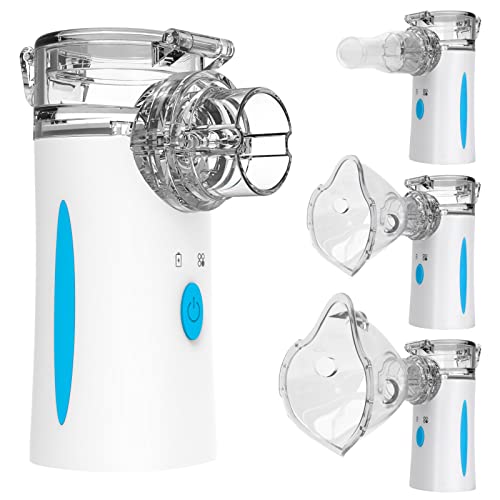
Twenty decibels is near the threshold of human hearing in a quiet room. Rustling leaves. A recording studio at rest. If the Naweti's less-than-or-equal-to 20 dB claim is accurate, it would be the quietest device on this page by a meaningful margin. There are zero buyer reviews. The claim has no validation at all.
Approach the spec with proportional skepticism: the bolder the claim, the more evidence you need, and this listing offers none. That said, the three output modes (power, gentle, soft) are independently useful regardless of the noise figure.
Starting an anxious animal on the softest mode (0.15 mL/min output) and gradually stepping up as they acclimate is a real behavioral technique. An animal that tolerates soft-mode treatment can often be moved to full power over several sessions, which reduces treatment time and improves medication delivery. That design feature has practical value even if the 20 dB claim turns out to be optimistic.
The self-cleaning function (hot water plus button press) is genuinely useful for owners who are inconsistent about manual membrane rinsing. Ultrasonic mechanism note: heat generation is a real trade-off for temperature-sensitive medications in humans. For pets using standard bronchodilators, this is generally not a concern, but verify with your vet if the prescription is unusual.
We earn a commission on purchases via these links. It does not change the price you pay or our ranking.
What actually matters when choosing a quiet nebulizer
1. Technology first: mesh vs. ultrasonic vs. jet
The three mechanisms produce very different noise profiles:
- Jet compressor: 45-65 dB. A pump drives air through a narrow jet to break liquid into particles. It's the classic clinical model, inexpensive, and works with every medication type. Also the loudest.
- Ultrasonic: 25-40 dB. A piezoelectric element vibrates at high frequency to generate aerosol. Quieter than jet, but produces heat, which can degrade temperature-sensitive medications.
- Mesh: 20-35 dB. A perforated membrane vibrates to push liquid through microscopic apertures. No heat, no compressor pump. The quiet ceiling for this category.
Note: product listings frequently mislabel mesh nebulizers as "ultrasonic." The two mechanisms are different. If a listing claims ultrasonic operation but shows no fan or cooling element, it is almost certainly mesh. The distinction matters for medication compatibility (see below).
2. Medication compatibility (more important than noise)
This is the hard gate that quiet specs cannot override.
Suspension medications (budesonide/Pulmicort, tobramycin, and similar) are incompatible with most mesh nebulizers. Suspension particles are larger and more viscous than solutions. They clog mesh membranes and result in significantly under-dosing. The device appears to work. The medication delivery rate drops below therapeutic levels without any obvious indication.
If you have a suspension medication prescription, verify mesh compatibility explicitly with the device manufacturer before purchasing. When in doubt, use a jet compressor. Jet works with all medication types without exception. Quiet is optional; correct medication delivery is not. Check with your pharmacist or prescriber.
3. dB reference scale
The claimed specs for nebulizers range from near-inaudible to "loud conversation." Here's the context:
| dB Level | What it sounds like |
|---|---|
| 20 dB | Rustling leaves; near-silent room |
| 25 dB | Quiet library at night |
| 30 dB | Whispered conversation at 5 feet |
| 40 dB | Quiet residential street |
| 45 dB | Quiet office; audible but not intrusive |
| 50 dB | Moderate rainfall |
| 60 dB | Normal conversation at 3 feet |
| 65 dB | Loud conversation; busy restaurant background |
All dB claims in this category are manufacturer-sourced. No independent testing standard exists for nebulizer noise measurement.
4. Pet-specific considerations
Animals have lower noise tolerance thresholds than the human adults being treated with the same devices. Observable stress begins at around 40 dB for cats, 45 dB for dogs. Most jet compressors run at 45-65 dB, which puts them at or above the threshold for both species.
Treatment duration compounds the problem. A 12-minute jet treatment at 55 dB is a sustained aversive stimulus. Most cats will not remain compliant. A 6-minute mesh treatment at sub-30 dB has a fundamentally different compliance profile. The noise improvement isn't just about comfort, it's about whether the treatment actually happens.
Mask fit matters separately from noise. A well-fitting mask on a quiet device still fails if the seal breaks and the animal inhales ambient air. Look for pet-specific mask geometry designed for the animal's muzzle profile.
5. Portability vs. quiet
"Portable" is not synonymous with "quiet." Battery-powered compressors exist and some run louder than tabletop models. Smaller motor, less acoustic insulation. Only mesh portables reliably clear the noise bar. If you need a quiet travel nebulizer, confirm the mechanism is mesh, not a compact jet compressor with a rechargeable battery.
FAQ
Are mesh nebulizers actually quieter than jet nebulizers?
Yes, in general. Mesh operates at 20-35 dB versus 45-65 dB for jet compressors. The mechanism explains the difference: mesh has no pump, no piston, just a vibrating membrane. The technology gap is real. What isn't independently verified are the specific dB numbers on individual product listings. Manufacturers state those without standardized testing. The general principle is solid; the exact figure on a specific product page may not be.
What decibel level is "quiet" for a nebulizer?
Below 40 dB is genuinely quiet. That's comparable to a library or a refrigerator hum, audible but not intrusive. Below 30 dB is near-inaudible in most home environments. Above 50 dB is disruptive for nighttime use next to anyone sleeping. Most jet compressors sit at 45-65 dB. Mesh devices that claim 20-35 dB are, if accurate, significantly below the disruption threshold for nighttime or infant-adjacent use.
Can I use a quiet mesh nebulizer with Pulmicort (budesonide)?
Probably not with a standard mesh nebulizer. Budesonide is a suspension medication, and suspension particles clog mesh membranes, resulting in under-dosing without any clear indication the device is malfunctioning. Verify mesh compatibility explicitly with the device manufacturer before purchasing. When in doubt, use a jet compressor. Jets work with all medication types. Check with your pharmacist or prescriber before making this decision.
What is the quietest type of nebulizer for cats?
Mesh. Cats show observable stress responses above around 40 dB, which rules out the majority of compressor nebulizers. Mesh devices in the 20-35 dB range are the practical choice for feline use. Look for compact designs with cat-specific mask geometry - the seal quality determines how much of the treatment actually reaches the airway. A silent device with a poorly fitting mask delivers less medication than a slightly louder device with a good seal.
Are "ultrasonic" nebulizers the same as "mesh" nebulizers?
No, but product listings frequently mislabel them. Ultrasonic nebulizers use piezoelectric vibration and generate heat during operation, which can degrade temperature-sensitive medications. Mesh nebulizers use a perforated membrane and produce no meaningful heat. They are genuinely cooler and generally quieter. If a product claims to be ultrasonic but shows no fan or cooling element in the device design, it is likely mesh. The distinction matters if you use temperature-sensitive medications or suspensions.