Marine Generators · 2026 edition
Quiet marine generators: what Amazon won't tell you
Here is what Amazon calls a "marine generator": a portable camping inverter with "RV, Tailgating & Marine" in the title. No water-cooled exhaust. No corrosion-resistant enclosure. No ABYC compliance. Just a generator someone decided to aim at boaters.
That is not necessarily a problem. Inverter generators genuinely work on boats, and most recreational boaters running dockside charging or overnight anchor loads will never need a purpose-built marine genset. But calling them marine generators is the kind of optimistic labeling that costs you $400 in the wrong product. We pulled the five units Amazon surfaces for this search. One has zero buyer reviews. We kept four, cut one, and told you what we found.
Why 'marine generator' is a misleading category
Real marine generators come from Fischer Panda, Westerbeke, Kohler Marine, Northern Lights, Onan/Cummins QD. They have water-cooled exhaust that absorbs most of the acoustic energy before it leaves the boat. They run at 1800 RPM instead of 3600, which halves the mechanical noise at the source. They sit on anti-vibration mounts in insulated engine rooms. They cost $3,000 to $15,000 installed.
None of them are on Amazon.
What Amazon sells as "marine generators" are portable inverter generators with "marine" in the keyword field. They are excellent products for what they are. Several of them are genuinely quiet. But they have no water-cooled exhaust, no marine certifications, and no corrosion protection designed for saltwater environments. If you know that going in, you can make a good decision. If you don't, you might spend $400 on something that turns out to be wrong for your use case.
The question to ask yourself: are you a day boater or weekend cruiser who wants to charge electronics and run a fan at anchor? A portable inverter handles that fine. Are you a liveaboard or long-distance cruiser who runs a generator daily for hours? You need a real marine genset, and you need to buy it somewhere else.
This page covers the four portable inverter generators Amazon surfaces for this search, what the noise specs mean in practice, and the context you need to decide whether they fit your situation.
All 4 picks at a glance
Sorted by noise level where data exists. The WEN has no independent dB verification - that column is honest, not missing.
| Product | dB | Type | Price | Badge | Verdict |
|---|---|---|---|---|---|
| Oxseryn 2800 | 58 dB | Inverter | $360 | Best for Dockside Use | Best-confirmed quiet spec. 58 dB backed by real buyer use. |
| ZEGJAW 2400 | 62 dB | Inverter | $280 | Best Budget Pick | Budget entry with standout THD spec for boat electronics. |
| 2400W Lightweight Portable Inverter Generator with Clean Power for Home | 63 dB | Inverter | $289 | Zero buyer reviews. Cannot verify anything on this unit. | |
| WEN 13 | No data | Tri-Fuel Inverter | $2189 | Best for Large Vessels | Liveaboard scale. Tri-fuel is a genuine marina advantage. |
Portable inverters for day boats and dock use
For day cruisers, small powerboats, and marina dockside charging, modern inverter generators do the job. Clean power for electronics, parallel capability for when you need more, and quiet enough to avoid complaints from neighboring slips - if you pick the right one and place it well.
Best for Dockside Use Oxseryn 2800W Inverter Generator
Best-confirmed quiet spec at a practical price for boat or dock use.
Oxseryn 2800W Inverter Generator
Best-confirmed quiet spec at a practical price for boat or dock use.
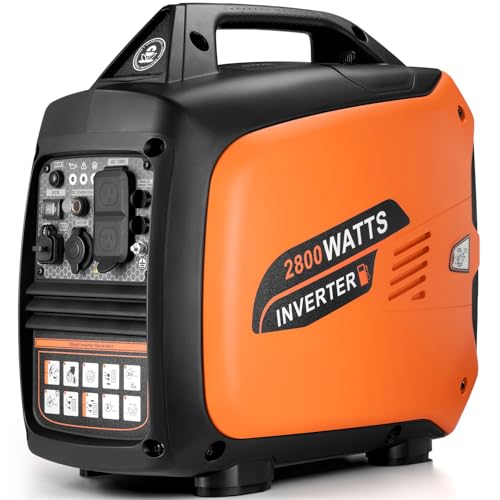
58 dBA at 23 feet is the strongest verified noise spec in this set. To put that in context: a normal conversation across the room runs around 60 dB. At marina distances, this generator is background noise, not an intrusion. Buyers confirm it. Someone who ran it continuously at a hunting camp - low load, extended hours, genuinely inconspicuous - found the quiet spec held in real extended use. That kind of feedback transfers to anchor use.
The runtime spec that matters for boaters is 9 hours at 25% load. Most overnight-at-anchor use is charging phones and laptops, running LED lighting, maybe a fan. That is 25% load territory. You get a full night on one tank without a 2am refuel. Parallel capability means two units can combine to 4800W peak if you eventually need more power - relevant for the small set of liveaboards considering inverters rather than dedicated marine gensets.
The honest caveats: this is not weatherproof. It needs a generator cover or a protected location - stern locker, cockpit with a cover rigged over it. The 1.1-gallon tank becomes a real inconvenience for all-day use; you will be refueling more often than feels convenient on a boat. And 40 pounds is manageable carrying it out of a car but different going up a companionway ladder on a pitching day.
We earn a commission on purchases via these links. It does not change the price you pay or our ranking.
Best Budget Pick ZEGJAW 2400W Inverter Generator
Parallel-capable budget pick with very low THD for sensitive boat electronics.
ZEGJAW 2400W Inverter Generator
Parallel-capable budget pick with very low THD for sensitive boat electronics.
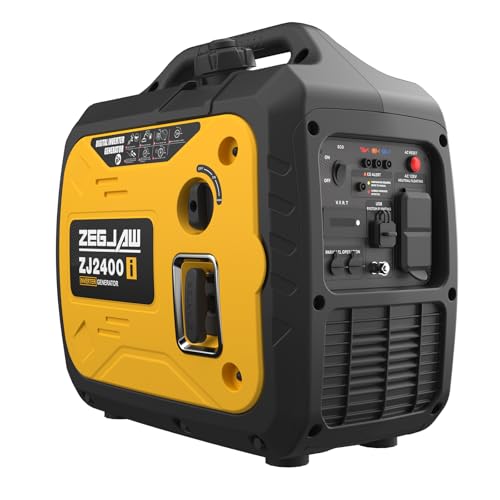
At $280, this is the realistic entry point for a boater who is not sure they will use a generator regularly. The financial logic is simple: if it turns out you only need it twice a season, less money sits idle.
THD of 0.2-1.2% is measurably better than the Oxseryn's under-3%, and meaningfully better than most generators in this price range. Why does that matter on a boat? Chartplotters, VHF radios, and navigation electronics are sensitive to power quality in ways that a circular saw is not. Cleaner power for the stuff that actually matters.
Two units in parallel deliver 30-amp service - confirmed by buyers who ran them that way for 30-amp RV hookups, which is electrically equivalent to a 30-amp marina slip. That's a real-world validation of the parallel spec, not just a box claim. At 62 dB, it's quieter than most outboard engines at idle. Useful reference for anyone trying to imagine it in a marina context.
Caveat: the data is thin. Newer product, limited buyer history. Enough signal to recommend it - not enough to be confident about long-term reliability. Buy it knowing that.
We earn a commission on purchases via these links. It does not change the price you pay or our ranking.
Redact 2400W Inverter Generator
Zero buyer reviews. Cannot verify any claim this product makes.
Redact 2400W Inverter Generator
Zero buyer reviews. Cannot verify any claim this product makes.

Zero buyer reviews. Specs look fine on paper: 63 dB, 9-hour eco-mode runtime, CO protection, parallel capable. There is no way to verify any of it. No buyer has confirmed the noise spec, no one has run it under real load, and the brand has no track record on Amazon.
For a generator you are relying on offshore, that is a real risk. Not a dealbreaker in principle - new brands earn trust eventually. Check back in six months. If it accumulates a meaningful feedback record with positive noise reports, it belongs in this comparison. Right now it does not.
We earn a commission on purchases via these links. It does not change the price you pay or our ranking.
When you need real power on board
Liveaboards and larger powerboats running AC units, watermakers, or full appliance loads need a different class of generator. More wattage, multi-fuel options, electric start. This is also where Amazon's inventory gets thin - real marine gensets for this use case are sold through marine dealers, not Amazon.
Best for Large Vessels WEN 13,000W Tri-Fuel Inverter Generator
The only liveaboard-scale option here. Tri-fuel is a genuine marina advantage.
WEN 13,000W Tri-Fuel Inverter Generator
The only liveaboard-scale option here. Tri-fuel is a genuine marina advantage.

Tri-fuel capability is the thing that makes this relevant in a marine context. Propane is available at virtually every marina. Gasoline jerry cans in a boat's aft compartment are a fire hazard. Natural gas works for dock-connected boats with a permanent slip. Switching fuel types with a button press is not a marketing feature on a boat - it is a practical advantage that single-fuel options cannot match.
The power capacity is real. 10,500W running on gasoline handles a full liveaboard load: AC unit (1,200-1,500W), watermaker (800-1,200W), refrigerator, and several outlets running simultaneously. Electric start matters more on a boat than on a job site - you are often starting it from a distance, possibly in rough conditions. WEN is an established inverter generator brand with real product support, which matters for equipment you are relying on offshore.
We have no noise data. WEN uses the word "quiet" in the marketing for this unit. A 550cc engine at 13,000W starting capacity will not be quiet by any reasonable definition of the word. We cannot tell you the actual dB level. If noise spec matters for your application, that is a real information gap. WEN's smaller inverter generators test well for noise; whether that scales to a 13,000W unit is a different question that we cannot answer with the data we have.
Also worth noting: at this size and $2,189, installation on a boat is not trivial. This is not "set it on the stern and plug it in." Fuel, weight, ventilation, and mounting all require real planning.
We earn a commission on purchases via these links. It does not change the price you pay or our ranking.
What actually matters for noise on a boat
Generator noise on a boat is not just about comfort. It is about anchorage etiquette, marina rules, and the relationship between a spec sheet number and what your neighbors actually hear.
The measurement distance trap
Manufacturer dB specs for generators use different test distances. The units above measure at 23 feet. Some brands measure at 9 feet (2.7 meters). Real marine genset specs are typically measured at 7 meters. These numbers are not comparable without knowing the test distance.
The practical reference point for marina and anchorage use is 7 meters (roughly 23 feet). Fischer Panda's flagship quiet genset hits 54 dB(A) at that distance. The inverters in this set claim 58-63 dB. The gap is real - and worth knowing before you assume a spec sheet tells the whole story.
There is also the water factor. Sound travels differently over flat calm water. A generator rated acceptable on land can be audible across a quiet anchorage 100+ meters away. Neighboring boats hear more than the spec sheet predicts.
Portable on deck vs. installed in an engine room
Placement transforms the real-world noise experience more than the spec sheet number. A portable inverter running at 57 dB placed on the swim step with exhaust aimed toward the neighboring boat is perceived as much louder than a 65 dB diesel genset properly installed in an insulated engine room. Location, exhaust direction, and vibration isolation change everything.
For portable generators on a boat: put them as far from neighboring vessels as possible. Point the exhaust away from the anchorage. A rubber mat under the unit reduces vibration transmission through the deck. Small differences in placement produce meaningful differences in what neighbors hear.
What real marine generators look like
The quiet benchmark is Fischer Panda: 54 dB(A) at 7 meters, water-cooled, no cooling fan, variable-speed engine that throttles down under partial load. Price range: $5,000-$15,000+ installed. For cruising or liveaboard use, that premium buys you engine room installation, wet exhaust, and the kind of quiet that does not wake neighbors in a crowded anchorage.
The 1800 RPM vs. 3600 RPM distinction matters more than any other spec. Marine diesel gensets at 1800 RPM run at half the mechanical speed of 3600 RPM units - less combustion frequency, less vibration, less noise, and significantly longer service life. It is the primary reason purpose-built marine gensets are quieter than portable gas units at equivalent wattage.
If you are at the point of seriously considering a fixed diesel genset, Amazon is the wrong place to shop. Northern Lights, Westerbeke, Onan Cummins QD, and Kohler Marine are sold through marine dealers with installation support. The cost is real. So is the difference.
Anchorage etiquette as a noise standard
No US regulation sets a dBA limit for boat generators. The real constraint is social. In popular anchorages, the informal rule is simple: if neighboring boats can hear you, you are too loud or running at the wrong time. Boating forums are consistent on this. Portable generators on deck - regardless of spec - are seen as inconsiderate in quiet anchorages. Many experienced cruisers will not run any generator after 9pm and will check with neighbors before starting one.
That social standard is stricter than any regulation. Factor it in when deciding what "quiet enough" means for your specific use.
FAQ
What is the difference between a marine generator and a regular generator?
Purpose-built marine generators have water-cooled exhaust that absorbs acoustic energy before it leaves the boat, anti-vibration mounts, and corrosion-resistant enclosures designed for wet environments. Portable generators are not marine generators - they are used on boats as a practical workaround, not as the purpose-built solution. The price difference (roughly $300-2,000 for portables vs. $3,000-15,000 for real marine gensets) reflects the engineering difference.
How quiet does a generator need to be for marina use?
There is no official standard, but 60-65 dBA at 7 meters is the informal threshold where marina neighbors stop noticing. The problem is that most Amazon specs are measured at 23 feet (7 meters), so the number is directly comparable - but on open water, sound carries further than the spec assumes. The real answer is that social norms in your specific anchorage set the limit, not a regulation.
Can I run a portable inverter generator on a boat?
Yes. Most recreational boaters do. The caveats: placement matters significantly (stern vs. bow, exhaust direction), they are not weatherproof and need protection from spray, and in quiet anchorages a portable on deck is often considered less courteous than an installed genset even at equivalent noise levels. For day use and occasional anchor charging, they are practical. For daily liveaboard use, a purpose-built marine genset is the right tool.
What wattage do I need for a boat generator?
It depends on what you are powering. Phone and laptop charging plus LED lighting runs 500-800W - any inverter here covers it. Adding a small portable AC unit pushes you to 1,500-2,000W minimum. Full liveaboard loads with AC, watermaker, and full appliances push to 4,000W and up. The inverters in the portable section handle the first two scenarios. The WEN 13,000W handles the third if you are comfortable with a large portable unit and its installation complexity.