Food Processors · 2026 edition
Quietest food processors (2026) - myths, data, 3 picks
Food processor manufacturers don't publish noise specs. That's not an oversight - it's a choice. Noise varies too much by ingredient load, fill level, and processing time for a single number to be honest. The result is that every buyer comparing models works from gut feeling and Amazon reviews.
Seven products were analyzed. Three made the cut. Four were dropped: one where a buyer flagged it as explicitly loud, another that turned out to be an immersion blender, and two with too little buyer signal to work with. What's left are the three where the noise evidence actually points somewhere useful.
Four things people get wrong about food processor noise
The standard advice on food processor noise is mostly recycled from appliance marketing. Here's what doesn't hold up.
Myth 1
All food processors are equally loud - noise doesn't vary
It varies. Buyers who've owned multiple machines consistently report real differences. People switching from Cuisinart and Ninja to KitchenAid flag it as noticeably softer, particularly on High. The variation is real. The problem is that nobody publishes a number, so you can't compare specs - only experiences.
Myth 2
Higher wattage means more noise
Motor design matters more than raw wattage. A well-engineered 400W motor with gear reduction can run quieter than a 900W universal motor at full speed. Wattage tells you power input. It tells you nothing about how efficiently that power converts to torque versus noise and heat. Stop using wattage as a noise proxy.
Myth 3
The dB spec tells you what you need to know
Most brands don't publish one. Unlike dishwashers (where EU regulations require disclosure) or some vacuum cleaners, food processors have no industry noise standard. Every product on this page has zero manufacturer dB specs. "Quiet operation" in a product title is marketing. The spec sheet tells you capacity and blade count. Ask buyers about noise.
Myth 4
A quiet food processor can't handle tough jobs
Quiet and capable are not opposites. A machine engineered for low noise usually has better motor geometry and more efficient power transfer - which tends to mean better performance per watt, not worse. The KitchenAid 7-Cup runs softer than machines three times its price and handles the same prep tasks. Loud is not a sign of power. It's a sign of poor engineering.
All 3 picks: noise tier and verdict
No product here has a published dB spec. Tiers reflect relative buyer noise signal and our editorial judgment - not numbers off a label.
| Product | dB | Size | Price | Badge | Verdict |
|---|---|---|---|---|---|
| KitchenAid 7 | No spec | 7-Cup Full-Size | $33 | Quietest Overall | Buyers compare it favorably to Cuisinart. Quietest relative signal on this page. |
| TWOMEOW Food Processor 4 Cup | No spec | 4-Cup Compact | $33 | Best Compact Pick | Claimed low-noise in specs. Dual bowls, compact. Durability caveats apply. |
| GANIZA Food Processors | No spec | 8-Cup Dual-Bowl | $35 | Best for Volume Prep | "Average for a food processor" per buyers. A workhorse, not a stealth machine. |
The Quieter Side of Food Processors
No food processor is silent. But some earn 'I forgot it was running' from buyers who've owned louder machines. This one earned that.
Quietest Overall KitchenAid 7-Cup Food Processor KFP0718
Buyers call it the quietest food processor they've owned, especially vs Cuisinart.
KitchenAid 7-Cup Food Processor KFP0718
Buyers call it the quietest food processor they've owned, especially vs Cuisinart.
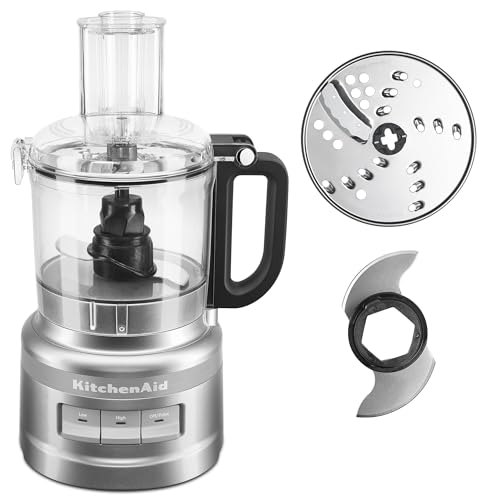
People who've owned Cuisinarts and Ninja food processors say this one runs softer. Not library-quiet, not "you could take a phone call over it," but noticeably less than what came before. The pattern is consistent enough across a very large buyer sample to take seriously. On High, some buyers initially thought something was wrong because it seemed slow. Results said otherwise.
The "looks slow but works" observation is telling. Lower RPM via better gear design produces less air turbulence noise at the blade. A motor that doesn't need to spin at full throttle to cut through carrots is a quieter motor. KitchenAid's engineering history in stand mixers shows up here in the way the unit handles load.
There's a durability caveat and it's worth saying plainly: reliability is mixed in the long-term buyer record. Blades and bowl longevity have detractors. Some units develop problems after heavy use. Buy from somewhere with a real return policy and don't expect this to outlast your Vitamix. As a value pick at under $35 that's legitimately quieter than the competition, the math still works for most households.
Assembly is user-friendly for people with limited grip strength. Buyers with hand conditions specifically praised the one-click bowl lock versus older Cuisinart designs that required more force. Small detail, but worth knowing if that applies to your household.
We earn a commission on purchases via these links. It does not change the price you pay or our ranking.
Compact Choppers for Small Kitchens
Smaller motor, smaller bowl, less counter footprint. For prep-focused households where a full-size processor is overkill and counter space is actually scarce.
Best Compact Pick TWOMEOW 4-Cup Dual-Bowl Food Processor
Spec claims low noise, dual bowls for meat/veg separation, fits tight kitchens.
TWOMEOW 4-Cup Dual-Bowl Food Processor
Spec claims low noise, dual bowls for meat/veg separation, fits tight kitchens.
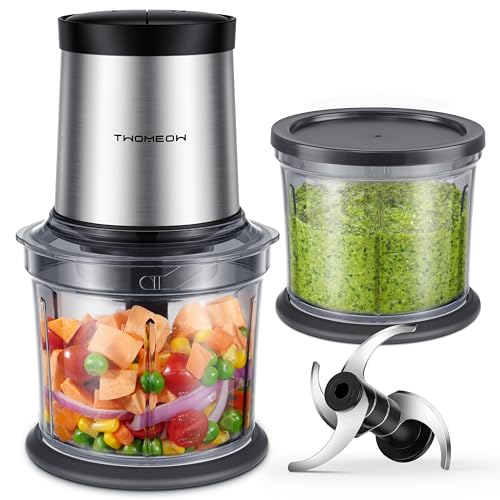
The dual-bowl design is the actual story here. Two separate 4-cup bowls let you chop meat in one and vegetables in the other without washing between tasks. That's a genuine kitchen workflow win, not a marketing feature. Most compact food processors give you one bowl and tell you to rinse it. This one doesn't make you choose.
The noise claim: the product spec states "low noise operation." This is the manufacturer's claim, not buyer-verified. No buyer specifically praised or criticized noise in the feedback we reviewed. We're including it as a positive signal without confirming it. Take accordingly.
The durability concern: some buyers report units failing after short use. This isn't a rare edge case. For a $33 machine, the failure rate in the review set is notable enough to mention. Buy from somewhere with a real return window.
For small kitchens, the compact footprint matters as much as the noise question. Buyers praise the chopping speed (most tasks done in 6-10 seconds), the ease of cleanup, and the form factor. If you're doing light daily prep in a tight space, this covers the brief. Just don't expect it to be a long-term workhorse.
We earn a commission on purchases via these links. It does not change the price you pay or our ranking.
Value Workhorses
Not the quietest option on the page. But thousands of buyers have used it for nut butter, meat prep, and weekly salsa and kept recommending it. The honest middle ground.
Best for Volume Prep GANIZA Dual-Bowl 8-Cup Food Processor
Honest average noise but thousands of buyers confirm it handles real prep work.
GANIZA Dual-Bowl 8-Cup Food Processor
Honest average noise but thousands of buyers confirm it handles real prep work.
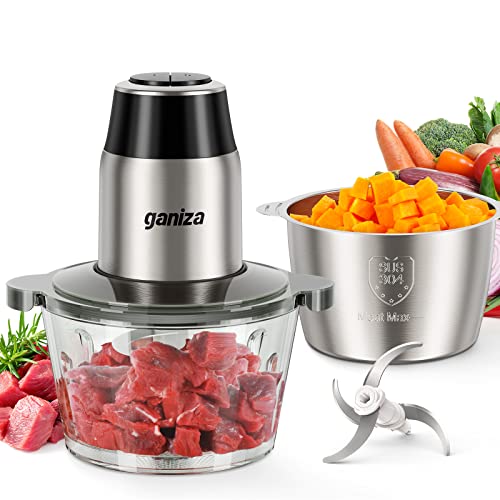
One buyer described the noise level as "average for a food processor." That's exactly what this tier reflects. This machine is not quiet. It runs at what most buyers accept as the expected noise of kitchen prep equipment - present, identifiable, not alarming. If your priority is noise, look at the KitchenAid above. If your priority is prep volume, this is where to start.
The glass-plus-stainless-steel dual-bowl configuration is different from the TWOMEOW's dual-plastic setup. Glass for vegetables, stainless for meat. Beyond hygiene, glass is better at dampening blade resonance than thin plastic, which may contribute to why the unit doesn't get flagged as unusually loud despite the larger motor.
Overheating protection: the unit shuts itself off under extended load. This is a safety feature, not a defect. For continuous processing tasks longer than a few minutes, expect a forced cool-down period. Plan your prep accordingly.
Hygiene note: food can accumulate near the motor housing through the lid opening. That area can't be rinsed. Buyers have flagged this. Wipe it down after use.
Buyers doing serious weekly prep - peanut butter from scratch, grinding meat, large-batch salsa - report reliable results. The durability record is mixed at the longer end, as is typical for this price tier. For high-frequency prep use rather than occasional tasks, budget for replacement at the two-year mark.
We earn a commission on purchases via these links. It does not change the price you pay or our ranking.
What actually matters when you want a quieter food processor
Motor type, not wattage
Brushless and induction motors run quieter than universal motors at equivalent power. Most budget food processors use universal motors (the cheap spinning kind) because they're inexpensive to manufacture. When a brand describes their motor as "powerful" without specifying the type, assume it's a universal. The rare machines that specify induction or brushless are usually the quieter ones.
Bowl construction
Thick polycarbonate or glass bowls dampen resonance. Thin clear plastic bowls vibrate and amplify motor noise. A bowl that flexes slightly when you press it is a bowl that rings. Glass is better than plastic on this axis; heavier polycarbonate beats thin polycarbonate. Weight is a reasonable proxy when you can't test in person.
Base stability
A food processor that slides around the counter during operation is also one that rattles. Anti-vibration rubber feet keep the unit grounded and reduce transmitted vibration through the counter surface. A machine that stays planted is meaningfully quieter than an equivalent machine that walks. Look for suction feet or heavy rubber pads, not just smooth plastic tabs.
Match bowl size to task
An oversized bowl for a small task creates more air turbulence at the blade. If you're running a 12-cup processor to chop one onion, the blade is spinning through mostly air. Noise comes partly from that air turbulence. Right-sizing the unit to your actual use case reduces both energy waste and noise - a 7-cup processor for typical household prep is the right tool, not a commercial-grade machine.
Pulse mode vs. continuous run
Pulse mode runs shorter and harder; continuous mode sustains motor load and resonance build-up. For tasks that allow pulsing, it reduces cumulative noise exposure even if peak noise is similar. Processing salsa or chopped vegetables in 6-10 second bursts is quieter in practice than running continuously. Know which mode the task actually needs.
Practical noise reduction at home
A thick silicone mat under the unit absorbs vibration and can knock a noticeable edge off the sound transmitted through the counter. Keep the bowl at least half full during processing to reduce blade turbulence. Process in shorter intervals rather than one long continuous run. These techniques are not substitutes for choosing a quieter machine, but they're real and they add up.
Why no dB numbers on this page
Dishwashers get rated in dB because EU regulations require it. Vacuum cleaners sometimes publish specs because competitive pressure pushed brands to do it. Food processors have neither. There's no regulatory requirement, no industry standard, and no competitive norm for disclosing noise levels. Brands occasionally use "quiet" or "low noise" in product copy, but virtually none back it with a measured number.
The result: buyers compare food processors on noise using only other buyers' experiences. That's the data we have. It's less precise than a dB spec, but it's real signal - and it tells you more than a marketing claim.
Common questions
Are food processors supposed to be loud?
They're inherently noisy appliances - motors, spinning blades, and airflow all generate sound. But there's real variation between models. Some run at what buyers describe as "surprisingly quiet for a food processor" and others sound like a blender full of gravel. The category average sits around what you'd expect from a vacuum cleaner in the next room. The quieter end is noticeably better. The louder end is genuinely disruptive.
Do food processors have dB ratings?
Rarely. Unlike dishwashers (where EU energy regulations require noise disclosure) or some vacuum cleaners, food processors have no standardized noise labeling requirement. Brands occasionally mention "quiet operation" in marketing copy but almost never attach a measured number to it. No product on this page has a manufacturer dB spec. We checked.
Is KitchenAid quieter than Cuisinart?
Buyer feedback suggests yes. People switching from Cuisinart food processors to the KitchenAid KFP0718 consistently report the KitchenAid runs noticeably softer, especially on High. This is buyer-derived signal from a large review set, not a lab test. It's also consistent enough across independent buyers to take seriously.
How can I make my food processor run quieter?
Place a thick silicone mat under the unit to absorb counter vibration. Keep the bowl at least half full during processing to reduce blade air turbulence. Use pulse mode for short discrete tasks rather than running continuously. Process in shorter intervals. None of these are substitutes for choosing a quieter machine, but combined they can take a noticeable edge off an otherwise loud unit.