Dog Hair Dryers · 2026 edition
Quietest dog hair dryers, ranked by honest claims
Searching for the quietest dog hair dryer means reading numbers nobody checks. Manufacturers claim anything from 40 to 85 decibels, no certification body tests any of it, and the one peer-reviewed field study of grooming force dryers clocked them at 94.8 to 108 dB at the operator's ear. The gap between the claims and the measurement is the story of this category.
The practical stakes are real. A dog that panics at the dryer once can stay dryer-phobic for months, and bath night turns into a soaked animal shaking itself dry on your couch. The quietest credible option here is a brushless handheld; the most honest option is a $28 brush that admits it is exactly as loud as the hair dryer in your bathroom.
This page covers 8 dryers across four groups: brushless handhelds, budget dryer-brush combos, force dryers for double coats, and one vacuum-dryer kit. First, what the numbers on the listings actually mean; then the comparison table, the picks by use case, a buying guide, and an FAQ.
What the Numbers on the Listings Actually Mean
Three kinds of noise claims exist in this category, and telling them apart does more for you than any single product pick. A few makers publish a range, like the Jellyfish's 40-75 dB. The range format is the credible one: it admits the machine gets loud at full speed. Most makers publish a single flattering number, measured at an undisclosed speed and distance. And the entire force-dryer class publishes nothing at all, because no honest number would look good in a listing.
For calibration: the only peer-reviewed field study of forced-air grooming dryers measured 94.8 to 108 dB at the operator's position. That is louder than every claim on every listing in this category, and it is the reason professional groomers wear hearing protection. Consumer units are smaller and gentler than salon rigs, but the physics does not change. Moving enough air to strip water out of a double coat is loud.
So this page ranks by claim credibility and motor class instead of pretending the numbers are comparable. A disclosed range beats a lone number. A brushless motor beats a brushed one. And a published 75-85 dB beats "whisper quiet" written above no number at all.
All 8 Picks at a Glance
Every dB figure is the manufacturer's own claim, unverified. "No spec" means the maker publishes no number. The noise tier is editorial judgment on claim credibility and motor type, not a measurement.
| Product | dB | Type | Price | Badge | Verdict |
|---|---|---|---|---|---|
| Jellyfish Handheld Dog Dryer | 40-75 dB | Handheld | $91 | Quietest Overall | Full-range disclosure and a brushless motor. The credible quiet pick. |
| buenkee Handheld Pet Dryer | <65 dB | Handheld | $66 | Cheaper brushless handheld; single-number claim, no stated test speed. | |
| KUUBIA 2-in-1 Dryer Brush | 75-85 dB | Dryer brush | $28 | Best Budget Pick | Openly hair-dryer loud. The honest claim, with a long track record. |
| POPET 3-in-1 Grooming Dryer | 75-85 dB | Dryer brush | $30 | Same spec sheet as the KUUBIA, zero visible history. Buy the original. | |
| SHELANDY Force Dryer | No spec | Force dryer | $76 | Best for Big Dogs | 2400W and 135 MPH for double coats. Loud class; bring ear protection. |
| shernbao Force Dryer | No spec | Force dryer | $60 | Huge speed range is the real noise control. Low end is the quiet mode. | |
| Xapigo Force Dryer | No spec | Force dryer | $54 | Cheapest force dryer. Longest hose. Claims a quiet duct, prints no number. | |
| oneisall Vacuum-Dryer Kit | <60 dB | Vacuum kit | $118 | Buy it for the hair-in-canister workflow, not for the dB claim. |
Brushless Handhelds for Nervous Dogs
The only two dryers here with brushless motors and sub-75 dB claims. Best fit for small to medium dogs, apartment bathrooms, and dogs that already distrust the sound of moving air.
Quietest Overall Jellyfish Handheld Dog Dryer
Only maker that publishes its full noise range, loud end included. Brushless.
Jellyfish Handheld Dog Dryer
Only maker that publishes its full noise range, loud end included. Brushless.
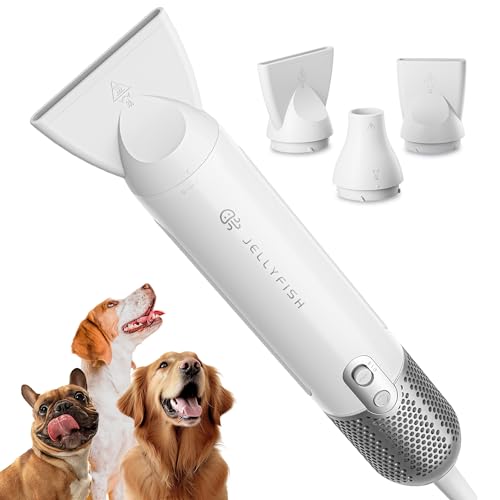
The spec that earns this the top spot is the one that makes it look worse: 40-75 dB. Every competitor prints its flattering minimum and stops. Jellyfish printed the loud end too, which means someone there decided to tell you the machine reaches hair-dryer volume at full speed. In a category where no claim can be verified, the maker that discloses against its own interest is the one to trust first.
Under the honesty, the hardware backs it up. The motor is a brushless DC unit, which removes the brush-on-rotor friction that gives cheap dryers their whine, and the whine is the part dogs react to. Airflow peaks at 62 m/s, temperature holds at one of four levels between 68°F and 176°F, and the whole thing weighs 1.21 lbs. At low speed with mild heat, this is about as unthreatening as forced air gets.
The catches: $90.79 makes it the second-most expensive item on this page, and at top speed its own numbers put it in loud territory. Run it low and slow for a nervous dog and accept the longer session. Nothing here is verified by an independent lab, because nothing in this category is.
We earn a commission on purchases via these links. It does not change the price you pay or our ranking.
buenkee Handheld Pet Dryer
Cheaper brushless handheld; single-number claim, no stated test speed.
buenkee Handheld Pet Dryer
Cheaper brushless handheld; single-number claim, no stated test speed.
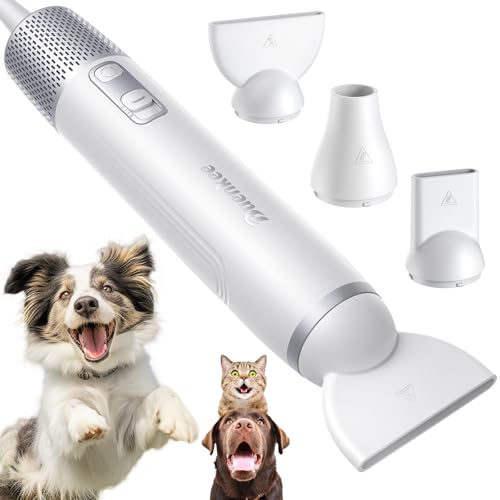
Set this next to the Jellyfish and the spec sheets nearly overlap: brushless motor, 62 m/s airflow, 1.2 lbs, three speeds, four temperature settings, three nozzles in the box. The price does not overlap. At $65.99 it undercuts the Jellyfish by about $25 for what reads like the same formula.
The difference is in what the noise claim leaves out. "Under 65 dB" names no speed setting and no distance, so it may describe the lowest speed only. The maker's drying pitch (a wet Corgi in 15 minutes) implies running it hard, and running it hard is where single-number claims quietly stop applying.
There is also no visible track record for this listing yet. Part of the $25 you save is certainty you give up. As a cheaper way into a brushless handheld it is a reasonable bet; just know it is a bet.
We earn a commission on purchases via these links. It does not change the price you pay or our ranking.
Dryer-Brush Combos for Small Dogs
Sub-$30 warm-air slicker brushes, not true dryers. Both admit to 75-85 dB, which is human-hair-dryer loud. For small dogs and cats that tolerate brushing better than blasting.
Best Budget Pick KUUBIA 2-in-1 Dryer Brush
Admits it is as loud as a human hair dryer. Honesty plus a deep track record.
KUUBIA 2-in-1 Dryer Brush
Admits it is as loud as a human hair dryer. Honesty plus a deep track record.
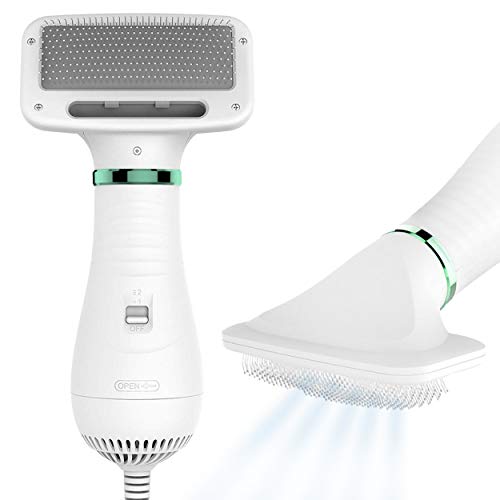
Here is the inversion this whole page is built on. The cheapest product makes the most honest claim: 75-85 dB, described by the maker itself as comparable to a human hair dryer. No whispering, no "ultra-silent" badge over a blank spec. A warm brush that tells you it is loud is more useful than a mystery box that tells you it is quiet.
Be clear about what it is. This is a 300W slicker brush that blows warm air through stainless bristles while you groom, 13 ounces in hand, two heat settings at 104°F and 140°F with an overheat cutoff. The maker says it dries a small dog in 5 to 15 minutes and, refreshingly, says outright that it will not fully dry a large dog. It is a finishing and touch-up tool for small dogs and cats, and the buyer pool behind it is deep; this listing has years of history where most of this category has none.
Good for: small dogs and cats, post-bath finishing, cold-day touch-ups, dogs that already like being brushed.
Not for: drying a soaked Golden. The maker says so itself; that job belongs to the force dryers below.
One usage note from the maker worth repeating: keep the brush moving. The 140°F high setting held still against skin is how warm becomes burn, and a slicker head concentrates contact.
We earn a commission on purchases via these links. It does not change the price you pay or our ranking.
POPET 3-in-1 Grooming Dryer
Same spec sheet as the KUUBIA, zero visible history. Buy the original.
POPET 3-in-1 Grooming Dryer
Same spec sheet as the KUUBIA, zero visible history. Buy the original.
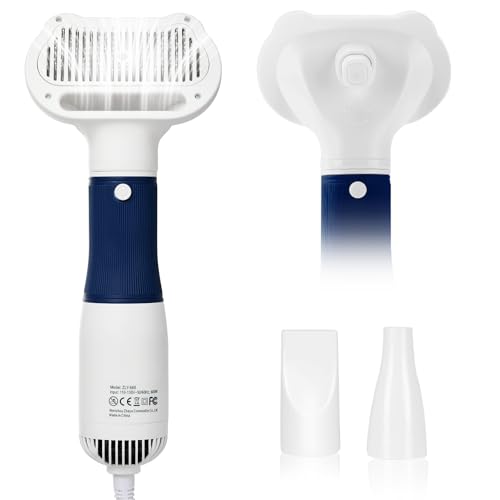
Read the listings side by side: 13 ounces, 104°F and 140°F heat settings, 75-85 dB, slicker head, auto shutoff. This is the KUUBIA's spec sheet with a different name on the shell, almost certainly the same factory mold, priced $2 higher.
Nothing here says the hardware is bad. What is missing is any visible history: no buyer pool, no track record, nothing to check the claims against. When the original with years of feedback costs less than the unknown twin, the decision makes itself.
We earn a commission on purchases via these links. It does not change the price you pay or our ranking.
Force Dryers for Double Coats
Hose-type velocity dryers that strip water out of thick coats. None of the three publishes a dB number, and the only field measurements of this class landed at 94.8-108 dB. Assume loud, plan for it.
Best for Big Dogs SHELANDY Force Dryer
2400W and 135 MPH for double coats. Loud class; bring ear protection.
SHELANDY Force Dryer
2400W and 135 MPH for double coats. Loud class; bring ear protection.
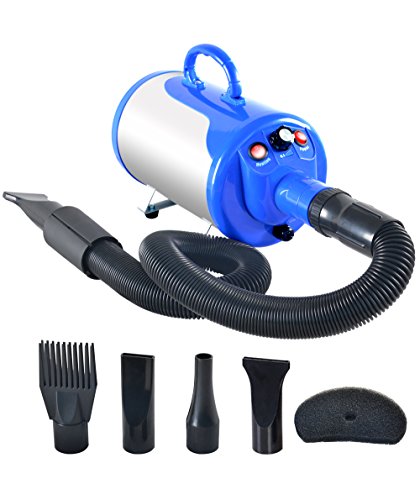
A force dryer works nothing like a hair dryer. Instead of evaporating water with heat, it blasts it off the coat with sheer air velocity, which is why a Husky that takes an hour under a handheld is done in a fraction of the time. The SHELANDY is the established name among the three here: 2400W adjustable motor, airflow from 65 to 135 MPH, two heat settings, a hose that stretches to 7 feet, and four nozzles.
On noise, the listing offers "new tech for noise reduction" and no number. Nobody in this class prints one, and the independent field study that measured forced-air dryers in actual use found 94.8 to 108 dB at the operator's ear. Treat any force dryer as a power tool: it earns its keep on double coats, and it is loud doing it. The adjustable motor is the real mitigation, since the low end of the dial is dramatically more tolerable than the top.
Make it work: towel-dry first so the machine runs shorter, start the dog on the low setting pointed away, keep sessions brief early on, and consider ear protection for yourself during long grooms. Best in class does not mean quiet; it means the best tool in a loud class.
We earn a commission on purchases via these links. It does not change the price you pay or our ranking.
shernbao Force Dryer
Huge speed range is the real noise control. Low end is the quiet mode.
shernbao Force Dryer
Huge speed range is the real noise control. Low end is the quiet mode.
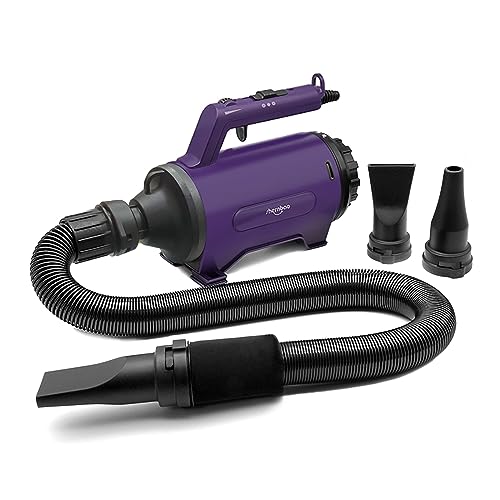
The speed dial is the reason to consider this one. It sweeps from 515 to 44,000 FPM, and that bottom end is the closest thing a force dryer has to a quiet mode: enough air to work on a sensitive dog without the full blast. The maker pitches it for exactly that, controlling output around noise-shy animals.
The redesign story holds some water too: roughly half the size and weight of older force dryers per the maker, with a heat ceiling of 118°F that runs gentler than most of the class. Wall-mount kit, a 4-to-8-foot hose, and three nozzles round it out. The noise claim itself is the words "quiet and durable" with nothing behind them, so apply the class assumption: loud, moderated only by that dial.
We earn a commission on purchases via these links. It does not change the price you pay or our ranking.
Xapigo Force Dryer
Cheapest force dryer. Longest hose. Claims a quiet duct, prints no number.
Xapigo Force Dryer
Cheapest force dryer. Longest hose. Claims a quiet duct, prints no number.
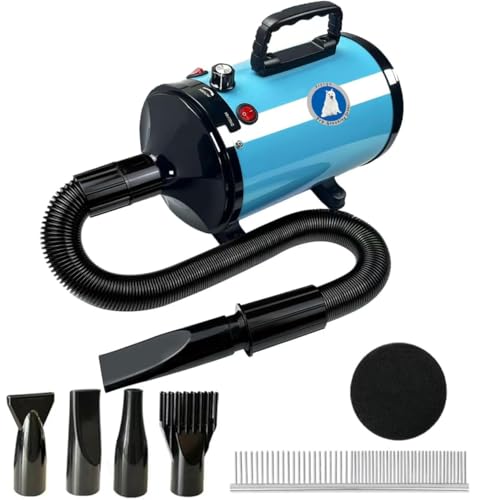
At $53.98 this is the cheapest way into real velocity drying on this page, and a few of its details are more thoughtful than the price suggests. The hose stretches to 90.5 inches, the longest here, and the hose joint carries a heat-insulating sleeve so it stays comfortable in hand during a long groom. A stepless speed dial and four nozzles cover the range from paws to back.
Its noise pitch is a "noise reduction air duct design," which may well take the edge off and cannot be checked, because no number accompanies it. Same class rule as its neighbors: assume loud, live on the low half of the dial, and let the anti-slip base and detachable rear filter make maintenance easy between grooms.
We earn a commission on purchases via these links. It does not change the price you pay or our ranking.
The Vacuum-Dryer Kit
One product, different problem: an 8-in-1 vacuum, dryer, and clipper kit that catches hair in a canister instead of scattering it. The under-60 dB claim compares it to vacuums, not to silence.
oneisall Vacuum-Dryer Kit
Buy it for the hair-in-canister workflow, not for the dB claim.
oneisall Vacuum-Dryer Kit
Buy it for the hair-in-canister workflow, not for the dB claim.
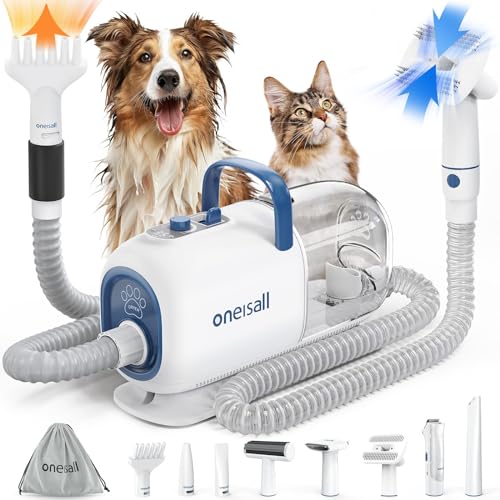
The problem this solves is not wet dog, it is hair everywhere. Suction brushes pull loose fur into the canister while you groom, clippers attach to the same hose so trimmings get caught mid-cut, and the dryer side covers seven heat steps from 95°F to 149°F with three speeds and three nozzles. For a heavy-shedding household, the floor staying clean is the whole pitch.
The noise claim deserves its context: under 60 dB, framed by the maker as quieter than a regular vacuum. That framing is the honest part. A grooming vacuum that undercuts your household vacuum is plausible; a vacuum that is also library-quiet is not, and the listing never says which of its several modes the number describes.
At $117.99 it is the most expensive item on this page, and the dryer function is the weakest of its jobs on a thick coat; it will not out-dry the force dryers above. Buy it as a shedding-management system that also dries, not as a quiet dryer that also vacuums.
We earn a commission on purchases via these links. It does not change the price you pay or our ranking.
What to Know Before You Buy
The dB problem, dog dryer edition
No certification body tests pet dryer noise, no standard defines how to measure it, and listings claim anything from 40 to 85 dB with no test conditions. Meanwhile the one peer-reviewed field study of forced-air grooming dryers recorded 94.8 to 108 dB at the operator's position. Those two facts do not reconcile, and the resolution is simple: claims are marketing, the study is data, and consumer units sit somewhere in between depending on size and speed.
What genuinely predicts quiet
Three things on a spec sheet carry real signal. A brushless motor removes the brush-on-rotor friction that produces high-pitched whine. A speed control with a usable low end lets you trade drying time for noise. And the drying method sets the floor: warm-air tools can afford to move less air than velocity tools, so a dryer brush starts quieter than a force dryer by design, whatever the listings say.
One more thing the numbers miss: pitch. Dogs hear frequencies far above the human range, so the motor whine registers with a dog before the broadband air noise does. This is why a brushless handheld can calm a dog that a technically quieter machine sends under the bed, and why the dB figure alone, even if it were honest, would not predict your dog's reaction.
Why not just use your hair dryer
Human hair dryers dry with heat, and dog skin burns at temperatures human scalps shrug off. Groomers and vets consistently warn against the practice for anything beyond a brief low-heat pass on a small dog. Pet dryers exist because the safe formula for animals is more air and less heat, which is the opposite of how a bathroom dryer is built.
dB reference scale for this category
Technique beats hardware
Towel-dry first, always; every minute of toweling is a minute the machine does not run. Introduce the dryer off and let the dog sniff it, then run it at the lowest speed pointed away, pair it with treats, and keep early sessions to a minute or two across several days. Never aim air at the face, ears, or groin, and keep the nozzle moving whenever heat is involved. For dogs that stay reactive, a snug ear wrap muffles both the sound and the air sensation; groomers reach for one before they reach for a quieter machine.
The speed-time tradeoff
Lower speed is quieter per minute and slower per session, so total noise exposure is speed multiplied by time. Some dogs do better with a short loud session, others with a long gentle one, and no spec sheet can tell you which yours is. Start gentle, watch the dog, and adjust.
FAQ
Can I use a human hair dryer on my dog?
For a quick pass on a small dog at the lowest heat, you can get away with it. As a routine tool, no. Human dryers dry with heat rather than airflow, dog skin burns at temperatures human scalps tolerate, and the motor pitch sits in a range dogs find harder to ignore. Pet dryers move more air at lower temperatures, which is the safe formula for animals.
How loud are dog dryers really?
Louder than the listings say. Claims in this category run from 40 to 85 dB, all self-reported with no test conditions. The only independent field study of forced-air grooming dryers measured 94.8 to 108 dB at the operator's ear. Consumer units are smaller than salon rigs, but treat every claim as marketing until your own ears say otherwise.
How do I get an anxious dog used to a dryer?
Low and slow. Let the dog sniff the machine while it is off. Next session, run the lowest speed pointed away from the dog and hand over treats. Keep sessions around a minute and repeat over several days before air ever touches fur. Mild cases settle in a session or two; fearful dogs need longer. An ear wrap helps reactive dogs by muffling both the sound and the feel of moving air.
Are brushless dog dryers quieter?
In principle, yes. A brushed motor generates friction noise where the brushes contact the rotor, and that contact produces much of the high-pitched whine dogs react to. Brushless designs remove that mechanism, so at the same airflow they run quieter and lower-pitched. It is the one quiet claim in this category with physics behind it, though it does not make any dryer silent at full speed.
Do quiet dog dryers dry as fast?
No. Quiet settings move less air, and less air means longer sessions. The workable approach is to towel-dry first, run the machine on the setting your dog tolerates, and accept the extra minutes. Total noise exposure is speed multiplied by time, so a gentler setting for longer is not automatically easier on the dog than a faster session; watch your own animal and adjust.